How to Build a 90-Day Growth Plan for Your Small Business
A yearly plan is often too far away to guide daily work. A 90-day plan is short enough to stay real and long enough to show results. Here is how to make one, step by step.
How do you make a 90-day growth plan for a small business?
To make a 90-day growth plan for a small business, look at where you stand today, pick one main goal for the quarter, choose two or three priorities that drive that goal, break them into weekly actions with an owner each, track a few numbers every week and review honestly at day 30, 60 and 90.
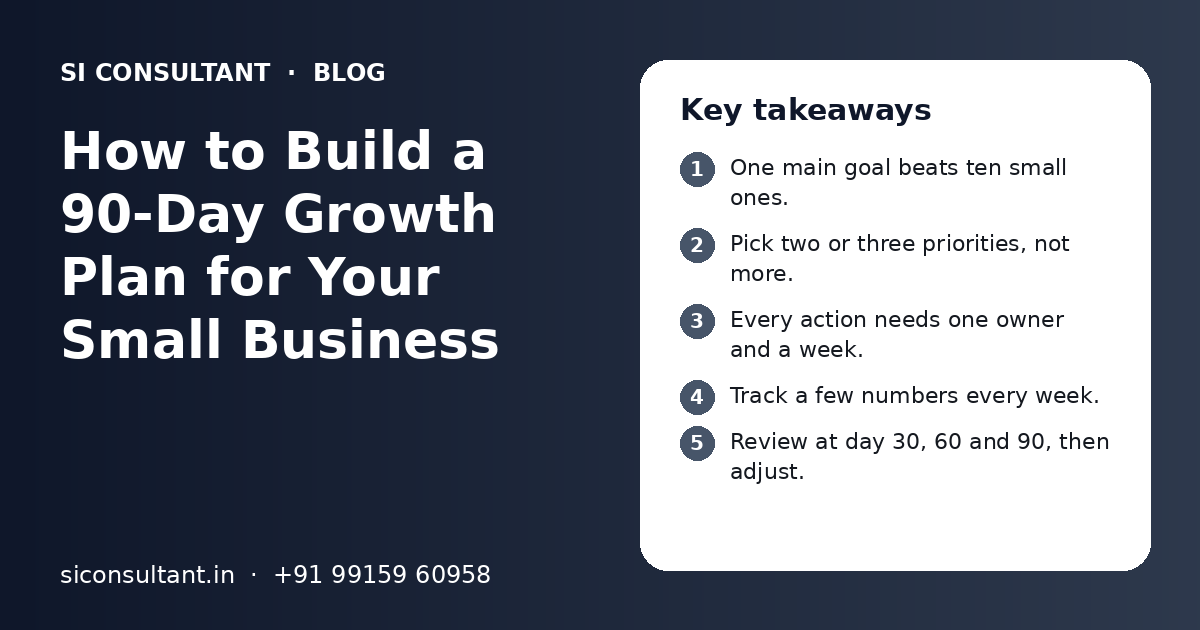
Key takeaways
- One main goal beats ten small ones.
- Pick two or three priorities, not more.
- Every action needs one owner and a week.
- Track a few numbers every week.
- Review at day 30, 60 and 90, then adjust.
What is a 90-day growth plan, and why does it work?
A 90-day growth plan for small business is a short, written plan with one main goal, a few priorities and weekly actions for the next three months. It works because it is close enough to feel urgent and simple enough to follow.
Many owners write a big yearly plan in April and forget it by June. Daily work, GST filings, staff issues and customer calls take over. A 90-day plan fixes this. It breaks the year into four short blocks, so you can learn and change direction four times a year.
| Point | Yearly plan | 90-day plan |
|---|---|---|
| Time frame | 12 months | 3 months |
| Level of detail | Broad goals and budgets | Specific weekly actions |
| How often reviewed | Often once or twice a year | Every week, with bigger reviews at day 30, 60 and 90 |
| Ease of change | Hard to change mid-year | Easy to adjust each quarter |
| Best use | Direction and budget | Getting things done |
You still need a yearly direction. The 90-day plan is how you turn that direction into work. Our growth consulting service often starts with exactly this kind of plan.
How do you check where your business stands today?
Start with a short, honest check of your sales, customers, costs and team. You cannot plan a route without knowing where you are starting from.
Spend one or two hours with your numbers from the last three to six months. Use your accounting software, GST returns, bank statements or even a simple sales register. You do not need perfect data. You need a rough, true picture.
- Monthly sales for the last three to six months
- Number of new customers and repeat customers
- Where new customers came from: referrals, Google, Instagram, WhatsApp, IndiaMART, walk-ins
- Average order or bill value
- Gross margin on your main products or services
- Cash in hand and money stuck with debtors
- Team capacity: who is overloaded and who has time
- Top three customer complaints
Ask three simple questions
- What is working well that we should do more of?
- What is clearly not working that we should stop?
- What is the one thing holding back growth right now?
If you find it hard to answer these alone, an outside view helps. Our business consulting for SMEs service includes this kind of review.
How do you choose one main goal for the 90 days?
Choose one main goal that matters most for your business right now, and write it as a clear number with a date. One goal keeps the whole team pointed the same way.
Common growth goals are more leads, a better lead to sale conversion, more repeat orders, a higher average bill or entry into a new city or channel. Pick the one that removes your biggest block. If you get many leads but few sales, more leads will not help. Fix conversion first.
| Weak goal | Clear goal |
|---|---|
| Grow sales | Raise monthly sales from our current level to a set target by the end of the quarter |
| Get more leads | Get a set number of qualified enquiries per week from Google and WhatsApp by day 60 |
| Improve repeat business | Get a set share of last year's customers to order again this quarter |
| Go online | Launch the online store and take the first paid orders by day 45 |
Set the target number yourself, based on your own data. Make it a stretch, but not a fantasy. If the team does not believe the goal, they will not work for it.
How do you pick the right priorities?
Pick two or three priorities that will move your main goal the most for the effort and money you have. More than three priorities usually means none get done well.
List every idea the team has. Then score each idea on two things: how much it can move the goal, and how easy it is to do in 90 days with your current team and budget. Keep the ideas that score high on both.
| Idea | Impact on goal | Ease in 90 days | Keep? |
|---|---|---|---|
| Follow up every enquiry within the same day | High | High | Yes |
| Fix the Google Business Profile and ask happy customers for reviews | Medium to high | High | Yes |
| Build a new website from scratch | Medium | Low | Maybe next quarter |
| Start a WhatsApp offer list for past customers | High | Medium | Yes |
| Open a second branch | High | Low | No, not this quarter |
This table is only an example. Your own list will depend on your business. Good priorities often come from fixing leaks first: slow replies, poor follow-up, unclear pricing or a weak offer. Our pages on sales process consulting and pricing strategy cover these areas.
Write down what you will NOT do this quarter too. Saying no to good ideas is how you protect time for the best ones.
How do you turn priorities into weekly actions?
Break each priority into small actions, give each action one owner and a week, and put them in one shared sheet. A plan without owners and dates is only a wish.
- 1
Split the quarter into 12 or 13 weeks
Make a simple sheet in Google Sheets or Excel with one row per week.
- 2
Break each priority into tasks
Each task should take no more than a week. 'Improve follow-up' becomes 'set up a lead sheet', 'write three WhatsApp follow-up messages' and 'train the sales team'.
- 3
Give each task one owner
One name, not 'team' or 'marketing'. Shared ownership usually means no ownership.
- 4
Set a week for each task
Spread the work. Do not put everything in the first two weeks.
- 5
Keep some buffer
Leave room for festival seasons, month-end closing, staff leave and surprises.
- 6
Share the plan
Put it where everyone can see it. Talk through it in a short team meeting.
Be realistic about team time. If your sales person also handles dispatch and billing, they cannot do ten new tasks a week. Plan around real capacity.
Plan around the Indian calendar
Look at the quarter ahead before you set dates. Festive seasons, wedding seasons, exam months and the financial year end on 31 March change demand and team availability. A plan for October to December looks very different from one for April to June.
Which numbers should you track every week?
Track three to five numbers that show whether you are moving toward your goal. Look at them every week, in the same sheet, at the same time.
Some numbers show results, like sales. Others show early signs, like enquiries or follow-ups done. Early-sign numbers are useful because you can act on them before the month ends.
| If your goal is | Track these weekly |
|---|---|
| More leads | Enquiries by source, cost per enquiry if you run ads |
| Better conversion | Enquiries followed up the same day, quotes sent, quotes won |
| More repeat orders | Repeat customers this week, messages sent to past buyers |
| Higher average bill | Average bill value, add-on or bundle sales |
| New channel or city | Listings live, first orders, returns or complaints |
Keep it simple. A shared Google Sheet updated every Monday is enough for most small businesses. If your leads are spread across WhatsApp, phone and email, a basic CRM can help. See our guide to CRM selection before you buy one.
How do you review the plan at day 30, 60 and 90?
Hold a short weekly check-in and a longer review at day 30, 60 and 90. Reviews are where you learn, fix problems and decide what to change.
Weekly check-in (20 to 30 minutes)
- Look at the weekly numbers
- Check which tasks are done, late or stuck
- Agree on the top actions for the coming week
- Remove blocks: who needs help or a decision?
Day 30, 60 and 90 reviews (one to two hours)
At day 30, ask if the priorities are right. At day 60, ask if you will reach the goal at the current pace, and what to change. At day 90, review the full quarter: what worked, what did not and what you learned. Use these lessons to write the next 90-day plan.
Good review habits
- Same day and time every week
- Numbers first, opinions second
- Honest talk about missed tasks
- Clear decisions with an owner
Review habits to avoid
- Skipping reviews in busy weeks
- Blaming people instead of fixing blocks
- Changing the goal every few weeks
- Long meetings with no decisions
What mistakes should you avoid in a 90-day plan?
The most common mistakes are too many goals, no owners, no weekly tracking and giving up after one bad month. Most plans fail in the follow-through, not in the writing.
| Mistake | What happens | Better approach |
|---|---|---|
| Too many goals | Effort spreads thin and nothing finishes | One main goal, two or three priorities |
| Copying another company's plan | Actions do not fit your customers or team | Start from your own numbers |
| Spending first, planning later | Money goes on ads or tools with no clear aim | Set the goal, then the budget |
| No owner for tasks | Everyone thinks someone else is doing it | One name per task |
| Not tracking weekly | Problems show up only at quarter end | Three to five weekly numbers |
| Quitting after a slow month | Good ideas are dropped too early | Adjust at day 30, do not abandon |
If you plan to spend on marketing during the quarter, set the budget against the goal. Our page on marketing budget planning explains how to do that sensibly.
How can SI Consultant help you build a 90-day growth plan?
SI Consultant helps you look at your numbers honestly, choose the right goal and priorities, and build a weekly plan your team can follow. We can also join your reviews to keep the plan on track.
We work with Indian SME owners and founders across trading, services, manufacturing, D2C and local businesses. If you are unsure whether you need outside help, read when to hire a business consultant first.
SI Consultant is backed by Shivah Web Tech, with 11+ years of experience and 500+ projects by the team. We work Monday to Friday, 9:30 to 6:30 IST, from Mohali. Book a free first call, and you get a clear quote based on what you need.
Related Pages
Growth Consulting
Find your next source of revenue and test it in a measured way.
Business Consulting
Practical help with process, team structure, pricing and planning.
Sales Process Consulting
A clear, repeatable sales process from first enquiry to payment.
Marketing Budget Planning
How to set, split and track a marketing budget that matches your goals.
Frequently Asked Questions
Why 90 days and not one month or one year?
One month is often too short to see results from new actions, especially in sales and marketing. One year is too long to stay focused, and plans drift. Ninety days is long enough to finish real work and see results, and short enough to keep urgency. It also fits neatly into the four quarters of the financial year.
Can a very small business with 2 or 3 people use a 90-day plan?
Yes. A small team needs focus even more, because time is limited. Keep the plan very short: one goal, two priorities and a handful of weekly tasks. The owner may hold most tasks, and that is fine. A simple sheet and a 20-minute weekly review on a fixed day is enough to make it work.
What if we miss our 90-day goal?
Missing the goal is not failure if you learn from it. In the day 90 review, look at which actions were done, which numbers moved and where the plan was wrong. Maybe the target was too high, or a priority did not work. Use these lessons to set a better goal and plan for the next quarter.
Should the whole team be involved in making the plan?
The owner should set the main goal, but involve key team members when choosing priorities and tasks. People who do the work often know the real problems and quick fixes. They are also more likely to follow a plan they helped build. Keep the planning meeting short and focused so it does not become a long debate.
What tools do I need for a 90-day growth plan?
You do not need special software. A Google Sheet or Excel file with goals, tasks, owners, weeks and weekly numbers is enough for most small businesses. If leads come from many places, a simple CRM can help track them. Use WhatsApp or a short meeting for weekly check-ins, but keep the plan itself in one place.
How is a growth plan different from a marketing plan?
A marketing plan covers how you attract and convert customers. A growth plan is wider. It can include sales process, pricing, repeat business, operations, hiring or new channels, depending on what limits growth. Sometimes the best growth action has nothing to do with marketing, such as faster follow-up or better delivery times.
Can a consultant make the 90-day plan for us?
A consultant can guide the process, bring an outside view, check your numbers and help you choose the right priorities. But the plan works best when the owner and team build it together, because they must carry it out. A good consultant helps you make better choices and stay on track, not hand you a plan to file away.
Talk to our team today
Call or WhatsApp +91 99159 60958. We reply fast, Monday to Friday.