Quick answer
How do you do competitor analysis for a small business?
To do competitor analysis for a small business, list five to eight real competitors, then compare each one on its offer, pricing approach, reviews, website, ads, social media and location. Put the findings in one simple sheet, look for gaps and patterns, and turn the top three findings into actions with an owner and a deadline.
Key takeaways
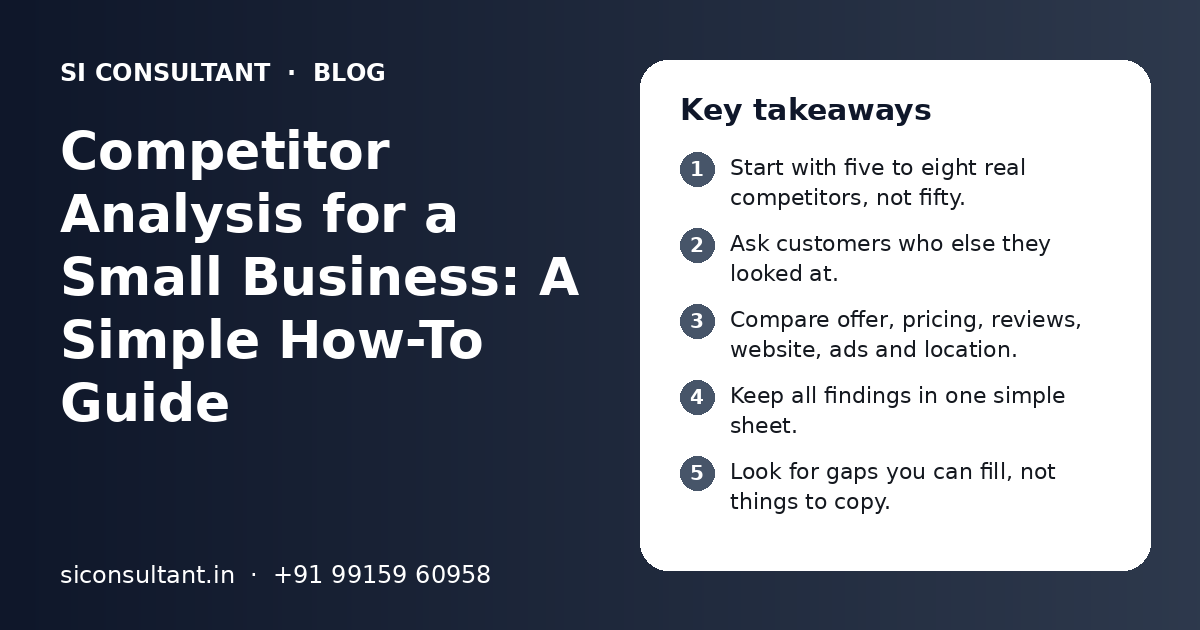
- Start with five to eight real competitors, not fifty.
- Ask customers who else they looked at.
- Compare offer, pricing, reviews, website, ads and location.
- Keep all findings in one simple sheet.
- Look for gaps you can fill, not things to copy.
- Turn the top three findings into actions.
What is competitor analysis and why does a small business need it?
Competitor analysis means studying the other businesses your customers could choose instead of you. Knowing how to do competitor analysis for a small business helps you see where you are stronger, where you are weaker and where there is a gap you can fill.
Many SME owners skip this. They feel they already know the market. But the market changes. A new shop opens nearby. A D2C brand starts selling on Instagram. An old rival improves its reviews. Without a regular look, you find out late, usually when sales drop.
- Set prices with more confidence
- Write a clearer message about why customers should pick you
- Find gaps, such as a service no one offers well
- Spot threats early
- Spend marketing money where it has a better chance of working
Competitor analysis works well next to a SWOT analysis. What you learn about rivals feeds the opportunities and threats boxes.
How do you find and list your real competitors?
Find competitors by asking customers who else they considered, searching the way a customer would, and checking marketplaces and directories. Then pick five to eight that matter most.
Three types of competitors
| Type | What it means | Example for a sweet shop |
|---|---|---|
| Direct | Sells the same thing to the same customers | Another sweet shop in the same market |
| Indirect | Sells something different that meets the same need | A bakery selling gift hampers at Diwali |
| Online or new | Reaches your customers through the internet | A brand selling sweet boxes on Instagram or quick-delivery apps |
Where to look
- Ask your last ten customers: "Who else did you check before buying from us?"
- Ask your sales team which names come up in calls and on WhatsApp
- Search Google and Google Maps the way a customer would, such as "CA near me" or "steel almirah manufacturer Ludhiana"
- Check Justdial, IndiaMART, Amazon, Flipkart or other marketplaces in your category
- Look at who exhibits at trade fairs you attend
Pick five to eight competitors: three or four direct, two or three indirect, and one or two online or new players. A short list you study well beats a long list you never finish.
What should you compare in each competitor?
Compare the things a customer sees before buying: the offer, the pricing approach, reviews, the website, ads and social media, and location or delivery. These show how each rival wins customers.
Offer
What exactly do they sell? Note their main products or services, packages, add-ons, warranty, delivery time and payment options like UPI, cards or credit terms. Write down what they say makes them different.
Pricing approach
You do not need exact prices for everything. Note the approach. Are they the low-price option or the premium one? Do they show prices openly or say "call for price"? Do they run frequent discounts or keep prices steady? Do they include GST in the quoted price? Our pricing strategy consulting page explains how to use this when setting your own prices.
Reviews
Read their Google reviews and marketplace ratings. Do not just look at the star rating. Read the words. Note the top three things customers praise and the top three complaints. Complaints are your best clue to a gap.
Website
Visit their website on a phone. Is it fast and clear? Can you call or WhatsApp in one tap? Do they show real work, prices or clear next steps? Which topics do they write about?
Ads and social media
Check which ads they run. The Meta Ad Library shows active ads on Facebook and Instagram, and the Google Ads Transparency Center shows ads from many advertisers on Google. Also note how often they post, which formats they use and how people respond.
Location and reach
For a local business, location matters a lot. Note where they are, parking, opening hours, delivery areas and whether they serve nearby towns.
How do you make a simple competitor comparison sheet?
Make one sheet with competitors in the columns and the comparison points in the rows, and put your own business in the first column. Fill it with short notes, not long essays.
Use Google Sheets or Excel so your team can add to it. Here is a sample layout. Replace the notes with what you actually find.
| Point | Your business | Competitor A | Competitor B | Competitor C |
|---|---|---|---|---|
| Main offer | ||||
| Pricing approach (low, mid, premium) | ||||
| Prices shown online? | ||||
| Review rating and count | ||||
| Top praise in reviews | ||||
| Top complaint in reviews | ||||
| Website on mobile (clear or poor) | ||||
| Running ads? Where? | ||||
| Social media activity | ||||
| Location and delivery area | ||||
| What they claim makes them different |
Add a date at the top of the sheet. When you repeat the exercise later, you can see what has changed.
Need help with your project?
Talk to the SI Consultant team. Free first call, simple advice, clear quote.
How do you do competitor analysis step by step?
Set a goal, list competitors, collect facts on each one, fill the sheet, find patterns and pick actions. A small business can finish a first round in one or two weeks with a few hours a week.
- 1
Set one clear goal
Decide why you are doing this. For example: "Why are we losing quotes?" or "Should we launch a new service?" A goal keeps the work focused.
- 2
List five to eight competitors
Use customer answers, search and marketplaces, as shown above.
- 3
Split the work
Give each team member one or two competitors. Sales staff often know the market well.
- 4
Collect facts from public sources
Check websites, reviews, ad libraries, social pages and marketplace listings. Visit shops if you are local.
- 5
Fill the comparison sheet
Use short notes. Add links or screenshots for proof.
- 6
Meet for one hour
Go through the sheet together. Ask: where are we clearly better, where are we clearly worse, and what does no one do well?
- 7
Pick three actions
Choose the three findings that matter most for your goal and turn each into an action.
Stay ethical. Use public information and your own experience as a buyer. Never ask a rival's staff for private data, and never copy their content, designs or photos.
How do you turn competitor findings into actions?
Look for gaps you can fill, strengths you should talk about more, and weak spots you must fix. Then write each one as a small action with an owner and a deadline.
| What you found | What it may mean | Possible action |
|---|---|---|
| Many rivals get complaints about slow delivery | Speed is a gap in the market | Promise a delivery time you can keep and say it clearly on your website and WhatsApp |
| Rivals have far more Google reviews than you | New buyers may trust them more | Ask every happy customer for a review with a simple link |
| No one shows prices online | Buyers may value clear pricing | Show starting prices or packages, if it suits your business |
| One rival runs many ads for a service you also offer | There is demand for it | Test a small, focused ad budget, with tracking in place |
| Your website is weaker on mobile | You may lose calls and enquiries | Fix the mobile site and add a click-to-call button |
Do not try to fix everything at once. Three actions done well beat ten actions half done. Our growth consulting team often turns findings like these into a short growth plan.
Where an outside review can help
If the findings point to weak online channels, a website audit or a social media audit can show what to fix first. If a rival's message is clearer than yours, a brand strategy review can help you say why customers should pick you.
What mistakes should you avoid in competitor analysis?
The biggest mistakes are studying too many competitors, copying instead of learning, guessing instead of checking, and doing nothing with the findings.
- Listing twenty competitors and finishing none
- Looking only at the biggest name in the market, not the ones you actually lose to
- Ignoring indirect and online competitors
- Copying a rival's prices without knowing your own costs
- Copying their content or design, which can harm your brand and may break the law
- Trusting only star ratings without reading reviews
- Rating your own business too kindly
- Making a sheet once and never updating it
- Ending with a report and no actions
A competitor's choices are not always right for you. They may have a different cost base, location or customer group. Use what you learn as input, not as a rule.
How often should a small business do competitor analysis?
Do a full review once a year and a quick check every quarter. Also do one before any big step, such as a price change, a new product or moving to a new city.
| When | What to do | Time needed |
|---|---|---|
| Once a year | Full review of all five to eight competitors | One to two weeks, part-time |
| Every quarter | Quick check of reviews, ads and offers | A few hours |
| Before a big decision | Focused review on that one question | A few days |
| When sales drop without a clear reason | Ask customers who else they are buying from | A few calls |
Link the review to your planning. A quarterly check fits well with your digital strategy and marketing reviews.
How can SI Consultant help with competitor analysis?
SI Consultant can run the analysis with you, add an outside view and turn the findings into a practical plan. We keep it simple and focused on decisions you need to make.
We usually start with a free call to understand your goal. Then we help you list the right competitors, compare offer, pricing approach, reviews, website, ads and reach, and agree on the top actions. It often links to our business consulting and go-to-market strategy work.
SI Consultant is powered by Shivah Web Tech, with 11+ years of experience, a 25+ member in-house team and 500+ projects. We work Monday to Friday, 9:30 to 6:30 IST, from our office in Mohali, and serve clients in India, the USA, UK, Canada, UAE and Australia. Cost depends on the number of competitors, markets and channels, so you get a clear quote after a free call. Contact us to book it.
Frequently Asked Questions
What is the easiest way to start competitor analysis for a small business?
Ask your last ten customers who else they looked at before buying from you. Their answers give you a real list of competitors. Then pick five of them and compare their offer, pricing approach, reviews, website and ads in a simple sheet. You can do this first round in a few hours a week.
How many competitors should a small business study?
Five to eight is a good number for most small businesses. Include three or four direct competitors, two or three indirect ones and one or two online or new players. A short list lets you study each one properly. You can always add more later if your goal needs it.
How can I see what ads my competitors are running?
Use the Meta Ad Library to see active ads on Facebook and Instagram, and the Google Ads Transparency Center to see ads from many advertisers on Google. Search by the competitor's page or business name. Note the offers, images and messages they repeat, as these often point to what is working for them.
Is it legal to do competitor analysis?
Yes, studying public information about competitors is a normal business practice. You can read their website, reviews, ads and social pages, and visit their shop as a customer. Do not copy their content, photos or designs, do not ask their staff for private data, and do not spread false claims about them.
Should I match my competitors' prices?
Not without checking your own costs and value first. A rival may have lower costs, a different customer group or may be losing money. Use their prices as one input. Then set your price based on your costs, the value you give and the customers you want to win.
Can I do competitor analysis without paid tools?
Yes. A small business can do most of it with free sources: Google search, Google Maps reviews, marketplace listings, competitor websites, social pages, the Meta Ad Library and the Google Ads Transparency Center. A shared Google Sheet is enough to compare them. Paid SEO tools help with deeper online research but are not needed to start.
What should I do after competitor analysis?
Pick the three findings that matter most for your goal. Turn each one into a clear action with an owner and a deadline, such as asking for more reviews or fixing your mobile website. Review progress after a month, and repeat a quick competitor check every quarter.