Quick answer
How do you plan succession in a family business?
To plan succession in a family business, start several years early. Agree on the goal with the family, pick and train the next leader, write down roles and decisions, move key customers, bank access and digital logins step by step, and settle ownership and legal papers with your CA and lawyer. Then hand over control in stages.
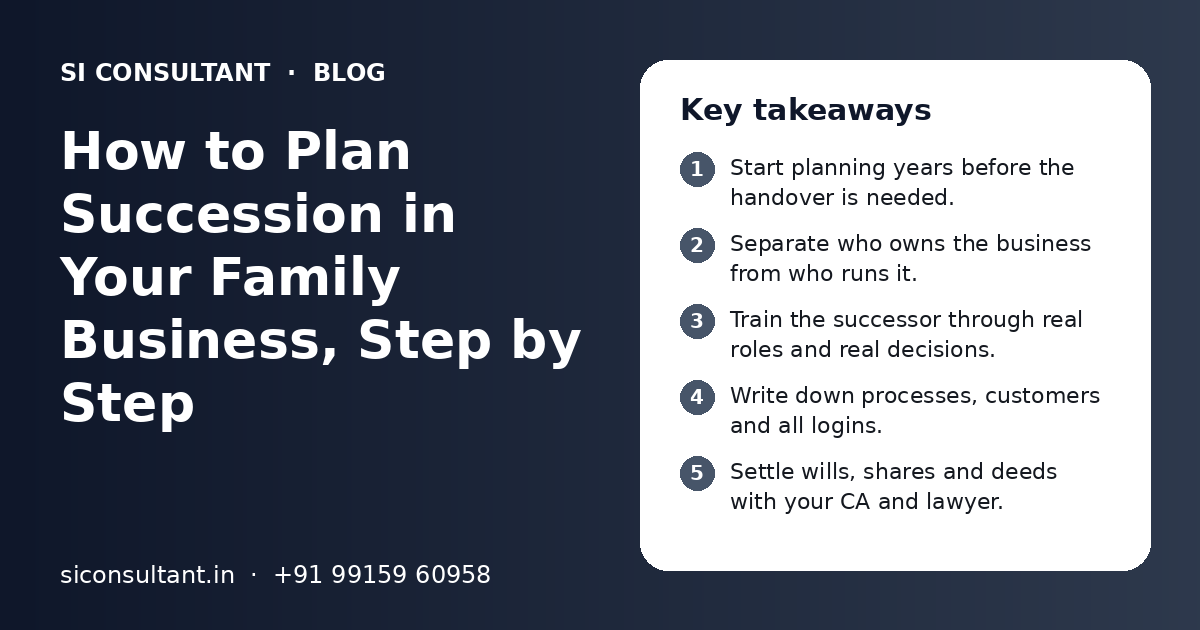
Key takeaways
- Start planning years before the handover is needed.
- Separate who owns the business from who runs it.
- Train the successor through real roles and real decisions.
- Write down processes, customers and all logins.
- Settle wills, shares and deeds with your CA and lawyer.
- Hand over control in stages, with clear dates.
What is succession planning in a family business?
Succession planning in a family business is a written plan for who will lead and own the business next, how they will be prepared, and how control will pass to them without hurting customers, staff or family relationships.
In many Indian SMEs, the business lives in the founder's head. The founder knows which distributor pays late, which supplier gives credit, which bank manager to call and what the GST portal password is. If the founder falls ill or steps back suddenly, all of this can be lost in a week.
A good plan is not only about one person. It covers leadership, ownership, money, people, customers and systems. It is part of the wider work we do in business consulting for SMEs.
When should a family business owner start succession planning?
Start succession planning at least three to five years before you want to step back. Start right away if the business depends on one person for most decisions, or if there is a health concern or family disagreement.
Early planning gives the successor time to learn, make small mistakes and earn trust from staff and customers. A rushed handover after an emergency often leads to lost customers and family conflict.
- Most approvals, payments and prices still need the founder
- Key customers deal only with the founder
- Only one person knows the bank, GST and website logins
- Children or relatives have joined but have no clear role
- Family members disagree about who should lead
- The founder wants to slow down in the next few years
- There is no written will, partnership deed update or shareholder agreement
If three or more of these are true, it is time to start. Treat succession as one of your yearly business goals, with owners and dates.
How do you choose the right successor?
Choose the successor on ability, interest and trust, not only on age or family position. The eldest child is not always the right choice, and sometimes the best leader is a trusted professional manager while the family keeps ownership.
Talk openly with each family member who may be involved. Ask what they want. Some children want to run the business. Others want a different career but still want to own a share. Both are valid choices.
| Option | When it fits | What to watch |
|---|---|---|
| One family member leads | One person has clear interest and ability | Other family members must still feel treated fairly |
| Two siblings share roles | Skills are different, such as sales and operations | Clear split of decisions to avoid daily clashes |
| Professional manager runs it, family owns | No family member wants to run it full time | Good reporting and a board or family review |
| Gradual sale to a partner or manager | No family successor at all | Fair valuation and legal advice |
| Sale of the business | Family wants to exit fully | Clean books and systems raise buyer trust |
Separate ownership from management
Owning shares and running the business are two different things. A family member can own part of the business without working in it every day. Keeping these apart reduces many fights, because it stops every owner from expecting a say in daily decisions.
What are the steps to plan succession in a family business?
The main steps are to agree on goals, choose the successor, write down how the business works, train the successor in real roles, settle ownership and legal papers, and hand over control in stages.
- 1
Hold a family discussion
Agree on what the family wants: keep, grow, share or sell the business. Write down the main points everyone accepts.
- 2
Pick the successor and a timeline
Name the next leader or leaders and set target dates for each stage of the handover.
- 3
Write down how the business runs
Record key processes, pricing rules, supplier terms, customer details and every login the business depends on.
- 4
Train through real roles
Move the successor through sales, purchase, accounts and operations, with real targets and real decisions.
- 5
Settle ownership and legal papers
Work with your CA and lawyer on wills, share transfers, partnership deeds and bank signatories.
- 6
Hand over in stages
Transfer one area at a time. The founder moves from doing to guiding, then to reviewing.
- 7
Review every quarter
Check progress against the plan and fix problems early, before they turn into family conflict.
These steps are simple to list but take time to do well. Many families find it helps to have an outside adviser run the meetings and keep the plan moving.
Need help with your project?
Talk to the SI Consultant team. Free first call, simple advice, clear quote.
What should be handed over, and in what order?
Hand over the lower-risk areas first, such as daily operations and staff, and the higher-risk areas last, such as large customers, bank signing powers and final pricing decisions.
| Area | What to hand over | Suggested stage |
|---|---|---|
| Daily operations | Staff scheduling, dispatch, stock checks | Early |
| Suppliers | Purchase orders, credit terms, supplier meetings | Early to middle |
| Team | Hiring, reviews, salary discussions | Middle |
| Customers | Joint visits, then successor as main contact | Middle to late |
| Pricing | Quotes, discounts, rate changes | Middle to late |
| Finance and banking | Signing powers, loans, GST and tax filings with the CA | Late |
| Strategy | New products, new markets, big spending | Last |
Customers need special care. In many businesses, buyers stay loyal to a person, not a company name. Take the successor on visits, introduce them on calls and let them handle small issues first. A clear sales process also helps, because customer history lives in a shared system rather than in one phone.
How do you hand over digital systems, logins and data?
Make a full list of every digital account the business uses, move each one to a business email the successor controls, add the successor as an admin, and store all passwords in a shared business password manager.
This is the part most families forget. A founder may have registered the domain, the GST portal access, the Google Business Profile and the WhatsApp Business number in a personal name or personal email. When that person is not available, nobody can get in.
- Net banking, UPI business account and payment gateway access
- GST portal, income tax portal and other government logins
- Digital signature certificate (DSC) holders and renewal dates
- Accounting software such as Tally, with user rights
- Domain name, hosting and website admin
- Business email, Google Workspace or Microsoft 365 admin
- Google Business Profile, social media pages and ad accounts
- WhatsApp Business number and any CRM or ERP software
A handover is a good moment to clean up old tools and move data out of notebooks and personal phones. Our digital transformation consulting and IT strategy consulting help you decide what to keep, what to replace and how to move data safely.
What are the common succession planning mistakes to avoid?
The most common mistakes are starting too late, choosing a successor only by family position, giving a title without real authority, and not writing anything down.
What works
- Starting years before the handover
- Open talks with every family member involved
- Written roles, decisions and timelines
- Successor makes real decisions with founder support
- CA and lawyer involved early
What goes wrong
- Waiting for a health scare or crisis
- Assuming the eldest child will take over
- Founder overrules the successor in front of staff
- Key logins and customer details stay with one person
- No will or updated deed, leading to disputes later
The founder's new role matters too
Many founders find it hard to step back after decades of hard work. Give the founder a clear new role, such as mentor, chairperson or head of one key relationship. A defined role makes letting go easier and avoids two bosses giving staff different orders.
What legal and money matters need attention?
Ownership, wills, share or partnership changes, bank signing powers and taxes all need attention. These rules depend on your business structure, so plan them with your CA and lawyer rather than on your own.
A sole proprietorship, a partnership firm, an LLP and a private limited company each pass to the next owner in a different way. A family business run as a HUF has its own rules too. The plan should match your structure.
- A clear will from the founder, reviewed by a lawyer
- Updated partnership deed or shareholder agreement
- Changes to bank signatories and loan guarantees
- Clarity on salaries, drawings and profit share for family members
- A family agreement or family constitution on how disputes are settled
- A cash plan for the handover years
Money is often where family tension shows up. A simple cash flow plan for the handover years helps everyone see what the business can afford to pay each family member.
How can SI Consultant help with family business succession?
SI Consultant can run family planning sessions, map how your business works, build a step-by-step handover plan, and set up the systems the next leader needs. We work alongside your CA and lawyer, not in place of them.
A typical engagement covers a review of roles and decisions, a written handover timeline, a list of every key process and login, and a plan for tools such as a CRM or ERP. It often links with automation consulting so the business runs less on memory and more on systems.
SI Consultant is powered by Shivah Web Tech, with 11+ years of experience, a 25+ member in-house team and 500+ projects. We work Monday to Friday, 9:30 to 6:30 IST, from our Mohali office. Cost depends on the size of your business and the support you need, so you get a clear quote after a free call. Contact us to book it.
Frequently Asked Questions
At what age should a business owner plan succession?
There is no fixed age. The better question is how long the handover will take. Most family businesses need several years to train a successor and move customers, banking and systems. Start as soon as the business depends heavily on one person, or when the next generation joins, rather than waiting for retirement or a health problem.
Should the eldest child always take over the family business?
No. The right successor is the person with the interest, ability and trust to lead. That may be the eldest child, a younger sibling, a son-in-law or daughter, or a professional manager. Family members who do not run the business can still own a share. Discuss this openly to keep the decision fair.
What is a family constitution?
A family constitution is a written agreement among family members about how the family business is owned and run. It can cover who may join the business, how family members are paid, how big decisions are made and how disputes are settled. It is usually not a strict legal document on its own, so get legal advice where needed.
How long does a family business handover take?
It depends on the size of the business and how ready the successor is. A small business with written processes and clean systems can hand over faster. A business where everything sits with the founder needs more time. Most families plan in stages over a few years, handing over one area at a time.
Can a professional manager run a family business?
Yes. Many families keep ownership and hire a professional manager to run daily work, especially when no family member wants the role. This works well with clear goals, regular reports and a family review meeting. The manager needs real authority, and the family should avoid giving staff instructions that go around the manager.
Do I need a consultant for succession planning?
Not always, but an outside adviser helps when family members disagree, when the business depends heavily on the founder, or when systems are mostly on paper. A consultant can run fair discussions, write down processes and build a clear timeline. Your CA and lawyer are still needed for wills, shares, taxes and other legal matters.
What happens if a family business has no succession plan?
If the founder is suddenly unavailable, staff may not know who decides. Customers may leave, payments may stop because nobody can sign, and family members may disagree about ownership. Key logins and supplier terms may be lost. A written plan, a will and shared access to systems reduce these risks a lot.