Quick answer
How do you hire your first manager in a small business?
To hire your first manager in a small business, first write down the work you want to hand over and the results you expect. Then decide whether to promote from within or hire from outside, test real skills in the interview, agree authority and targets in writing, and hand over work in stages over the first three months.
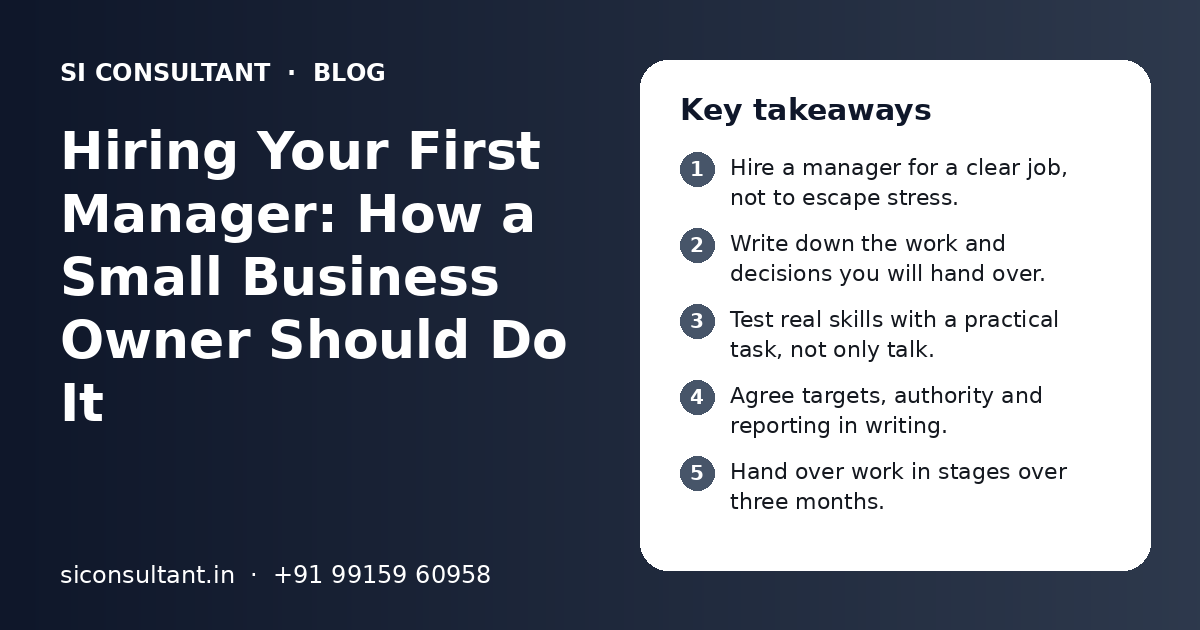
Key takeaways
- Hire a manager for a clear job, not to escape stress.
- Write down the work and decisions you will hand over.
- Test real skills with a practical task, not only talk.
- Agree targets, authority and reporting in writing.
- Hand over work in stages over three months.
- Meet every week and stay close at the start.
When is a small business ready for its first manager?
You are ready when the owner has become the bottleneck: work waits for your decision, the team keeps asking you small questions and growth has slowed because you have no time to plan. You also need steady cash flow to pay a manager for many months.
Knowing how to hire your first manager in a small business starts with being honest about why you want one. Some owners hire because they are tired, but do not plan to let go of any decisions. That person then becomes an expensive assistant.
- You spend most of the day on tasks someone else could do
- Staff wait for you before they can finish simple work
- Customers complain about slow replies or missed follow-ups
- You have no time for sales, partners or planning
- The business has steady monthly income, not one-off spikes
- You are willing to let someone else make some decisions
If most of these are true, it is time. If cash is tight, read our guide to cash flow planning first.
What should your first manager actually do?
Your first manager should take over one clear area of work that eats most of your time, such as daily operations, sales follow-up or store running. Do not ask one person to manage everything from day one.
| Type of first manager | Suits businesses where | Main results to expect |
|---|---|---|
| Operations manager | Orders, delivery or service quality take most of your time | Work done on time, fewer errors, clear daily routines |
| Sales manager | Leads come in but follow-up is weak | Faster replies, regular follow-up, steady pipeline |
| Store or branch manager | You run a shop, clinic, outlet or second branch | Smooth daily running, staff rosters, stock and cash control |
| Office or admin manager | Billing, GST papers, vendors and HR tasks pile up | Bills raised on time, vendors paid, records in order |
Write a role scorecard before you post any job. It keeps you clear and gives candidates a fair picture. If you are not sure which area hurts most, a short review with a business consultant can help you decide.
How to hire your first manager in a small business: step by step
Follow a simple process: define the role, decide the source, test skills, check references, agree terms in writing and plan the first 90 days. Each step lowers the chance of a costly wrong hire.
- 1
List the work you will hand over
For two weeks, note every task and decision you handle. Mark the ones a manager could take.
- 2
Write the role scorecard
Set the purpose, three to five key results, the decisions the manager can make alone and the reports you want.
- 3
Decide inside or outside
Look at your current team first. Then decide if you need fresh experience from outside.
- 4
Spread the word
Use your network, industry groups, referrals and job portals. Share the role clearly, including what success looks like.
- 5
Interview with real situations
Ask how they handled past problems. Give a short practical task based on your business.
- 6
Check references
Call past employers and ask about reliability, honesty and how they led people.
- 7
Agree terms in writing
Give a clear offer letter with role, pay, probation, notice period and reporting line.
- 8
Plan the first 90 days
Decide what they learn, what they take over and when you will review progress.
Should you promote from within or hire from outside?
Promote from within when a trusted team member already knows the work and shows leadership. Hire from outside when you need skills or systems that nobody in your team has seen before.
| Point | Promote from within | Hire from outside |
|---|---|---|
| Knows your business | Yes, from day one | Needs time to learn |
| Trust | Already built | Has to be earned |
| New ideas and systems | Fewer | More, from other companies |
| Team acceptance | Can be hard if peers become juniors | Often easier, as a fresh start |
| Time to fill | Usually quick | Usually longer |
In many Indian family businesses, owners also think of giving the role to a relative. This can work if the relative has the skills and is judged by the same targets as everyone else. If not, it can quietly hurt team morale.
Need help with your project?
Talk to the SI Consultant team. Free first call, simple advice, clear quote.
What should you look for in a first manager?
Look for someone who is reliable, can plan work, can guide people without shouting and tells you bad news early. Industry knowledge helps, but honesty and ownership matter more in a small business.
Good signs
- Gives clear examples of problems they solved
- Talks about the team, not only about themselves
- Asks smart questions about your numbers and customers
- Comfortable with simple tools like sheets and a CRM
Warning signs
- Only big talk, no real examples
- Blames past bosses and teams for everything
- Wants a big title but avoids hands-on work
- Cannot explain basic numbers in their past role
Questions to ask in the interview
- Tell me about a time a team member kept missing targets. What did you do?
- What would you change in our business in your first month, and what would you leave alone?
- How do you report progress to an owner, and how often?
- Tell me about a mistake you made as a manager and what you learned.
For a sales manager, also check if they can work with a clear sales process and follow-up system.
What affects the cost of hiring your first manager?
The cost depends on the role, the experience you need, your city and the market for that skill. Think about the full cost, not only the monthly salary.
- Level of experience and the size of team they will lead
- Your city or region and local demand for the skill
- Statutory costs such as PF and ESI where they apply
- Incentives linked to targets, if you offer them
- Time spent by you in training during the first months
- Tools such as a laptop, phone, software licences and travel
- The cost of a wrong hire: lost time, lost customers and rehiring
Check salary ranges on job portals and with people in your industry before you make an offer. Plan the cost into your yearly budget so it does not strain cash flow. Our guide on how to set yearly business goals shows how to plan hiring along with sales targets.
How do you onboard and hand over work to a new manager?
Hand over work in stages. In the first month the manager learns and watches, in the second month they run parts of the work with your support, and by the third month they own the area with weekly reviews.
| Period | Manager's focus | Owner's role |
|---|---|---|
| Days 1 to 30 | Learn the team, customers, products and numbers | Explain how things work, introduce key people |
| Days 31 to 60 | Run daily work and a few decisions with your approval | Review decisions, give feedback every week |
| Days 61 to 90 | Own the area and report on agreed numbers | Step back, meet weekly, act only on big issues |
Tell your team clearly, in person and on your office WhatsApp group, what the new manager now decides. If staff can still go around the manager to you, the manager will never gain authority.
Write down your main processes before the manager joins. Simple checklists help. Our business checklists are a good place to start, and automation consulting can remove repeat tasks so the manager can focus on people and results.
What mistakes do owners make when hiring their first manager?
The most common mistakes are hiring in a hurry, giving a big title with no real authority, and taking decisions back as soon as something goes wrong. Each one makes a good manager leave or a weak one stay.
- Hiring the first person who seems confident, without a practical task
- Not writing down the role, results and decision limits
- Giving the title but still approving every small purchase
- Allowing staff to bypass the manager and come to the owner
- Judging the manager by feeling instead of agreed numbers
- No weekly meeting, so small problems grow quietly
- Keeping a clearly wrong hire for too long
These are some of the same patterns we see when a business grows too fast. Our post on mistakes to avoid when scaling a small business covers more of them.
How can SI Consultant help you hire your first manager?
SI Consultant helps owners decide which manager to hire first, write the role scorecard, plan interviews and set up a 90-day handover. We give practical advice in simple language.
We look at your numbers, your team and where your time goes, then suggest the role that will free you the most. For fast-growing teams, see growth consulting. New founders can start with startup consulting.
SI Consultant is powered by Shivah Web Tech, with 11+ years of work, a 25+ member in-house team and 500+ projects. We serve owners in India, the USA, the UK, Canada, the UAE and Australia. The work depends on your size and how much support you need, so you get a clear quote after a free call. Book a free call to start.
Frequently Asked Questions
When should a small business hire its first manager?
Hire your first manager when you have become the bottleneck and the business has steady income to pay for the role. Signs include staff waiting for your approval on small things, slow replies to customers and no time for planning or sales. If you still need to approve every decision yourself, fix that habit before you hire.
What should a first manager do in a small business?
A first manager should own one clear area that takes most of the owner's time. This is often daily operations, sales follow-up, store running or office administration. Write down the main results you expect, the decisions they can make alone and the numbers you will review each month. Add more areas later once they succeed.
Is it better to promote an employee or hire an outside manager?
Promote from within if a trusted team member knows the work and has shown they can guide others. Hire from outside if you need new skills or systems. A good worker is not always a good manager, so test an inside candidate with a small team task first. Judge both options against the same role scorecard.
What interview questions should I ask a manager candidate?
Ask about real past situations. For example, how they handled a team member who kept missing targets, a mistake they made and what they learned, and how they report progress to an owner. Then give a short practical task based on your business. Real answers and real work tell you more than a polished CV.
How long does it take for a new manager to settle in?
Plan for about three months. In the first month they learn your team, customers and numbers. In the second month they run daily work with your support. By the third month they should own the area and report on agreed numbers in a weekly meeting. Some roles may take longer, so review progress honestly.
How much does it cost to hire a manager in India?
It depends on the role, the experience needed, your city and the local demand for that skill. Also count statutory costs where they apply, incentives, tools and your own training time. Check salary ranges on job portals and with people in your industry. If you want help planning the role and budget, you get a clear quote after a free call.
What if my first manager does not work out?
Review the facts first. Check if the role, targets and authority were clear, and if you gave real support. If the gaps are in skill or attitude and do not improve after clear feedback, end the probation politely and as per the offer letter. Learn from it, update your role scorecard and hire again with a better process.