Quick answer
Bootstrapping vs raising funding for a startup: which is better?
In bootstrapping vs raising funding for a startup, neither is always better. Bootstrapping means growing with your own savings and customer revenue, so you keep full control but grow more slowly. Raising funding brings outside money for faster growth, but you give up part of the ownership and accept investor expectations. The right choice depends on your model and goals.
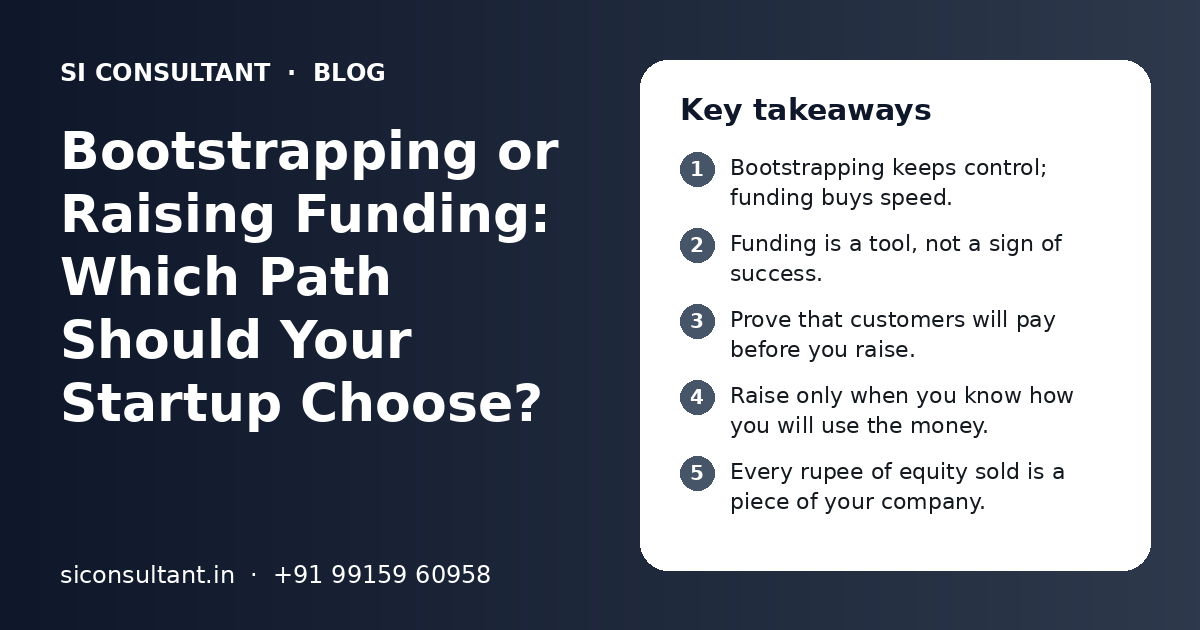
Key takeaways
- Bootstrapping keeps control; funding buys speed.
- Funding is a tool, not a sign of success.
- Prove that customers will pay before you raise.
- Raise only when you know how you will use the money.
- Every rupee of equity sold is a piece of your company.
- Get a CA and lawyer to check every deal.
What is the difference between bootstrapping and raising funding?
Bootstrapping means you build the startup with your own savings and the money customers pay you. Raising funding means you take money from outside investors, usually in exchange for a share of your company.
The debate on bootstrapping vs raising funding for a startup is often loud on social media. Funding news gets attention, so it can look like every serious founder must raise money. That is not true. Many strong Indian businesses grew for years on their own revenue. Others needed outside money to get started at all.
There is also a middle path. Some founders use friends and family money, a bank loan or a small grant from an incubator or a government scheme. Each has its own rules, so read the official terms and take advice before you sign.
How do bootstrapping and funding compare side by side?
Bootstrapping wins on control, focus and freedom. Funding wins on speed, hiring power and room to make long bets. The table below shows the main trade-offs.
| Factor | Bootstrapping | Raising funding |
|---|---|---|
| Ownership | You keep all or most of it | You share it with investors |
| Control | You make the decisions | Investors may get a say in big decisions |
| Speed of growth | Steady, limited by revenue | Faster, if the money is used well |
| Pressure | From cash flow and bills | From investor targets and timelines |
| Focus | Profit and paying customers early | Growth and market share, often before profit |
| Founder time | Spent on sales and product | A large part goes to pitching and investor updates |
| Risk | Personal savings at stake | Company must grow fast enough to raise again |
| Exit expectations | None unless you want one | Investors usually expect a sale or listing someday |
Neither column is "good" or "bad". A business that needs to win a market quickly may need funding. A service business that earns from the first month may never need it.
What are the pros and cons of bootstrapping a startup?
Bootstrapping gives you full control and a strong habit of earning before spending. The main downsides are slower growth, personal money at risk and a tight team in the early years.
Pros of bootstrapping
- You own the business and keep the profit
- You decide the pace, the market and the culture
- You build profit habits from day one
- You talk to customers, not investors
- No pressure to sell the company
Cons of bootstrapping
- Growth is limited by what you earn
- Your own savings and family money are at risk
- Hard to hire senior people early
- A bigger, funded rival may move faster
- The founder often does every job at once
Businesses that often suit bootstrapping
- Service businesses such as agencies, consulting, training or IT services.
- Niche software sold to a clear group of businesses who pay monthly.
- D2C brands that start small and grow with repeat customers.
- Local businesses with fast cash cycles, such as clinics or cafes.
If you bootstrap, pricing matters even more, because every sale has to fund the next step. Our pricing strategy consulting helps founders set prices that protect margin from the start.
What are the pros and cons of raising funding?
Raising funding lets you build faster, hire earlier and take bigger bets. In return, you give up part of the ownership, share decisions and accept pressure to grow quickly.
Pros of raising funding
- Money to build and hire before revenue comes in
- Ability to grab a market before others
- Advice and contacts from experienced investors
- Easier to attract senior hires
- Some cushion if early plans fail
Cons of raising funding
- You own a smaller share after each round
- Investors expect fast growth and a future exit
- Fundraising takes months of founder time
- Legal terms can limit your choices
- Easy money can hide a weak business model
Businesses that often need funding
- Products that need a long build before anyone can pay, such as deep tech or hardware.
- Marketplaces and platforms that must win many buyers and sellers at once.
- Businesses where the market is large and speed decides the winner.
- Businesses with heavy upfront costs such as factories or stock.
Need help with your project?
Talk to the SI Consultant team. Free first call, simple advice, clear quote.
When should a startup bootstrap, and when should it raise funding?
Bootstrap when customers can pay you early and you can grow step by step. Consider raising funding when you have proof that customers want the product and money is the main thing holding growth back.
Many founders do both. They bootstrap first, prove the idea with real sales, and raise later from a stronger position. Investors also find it easier to back a business that already has paying customers.
| Your situation | Path that often fits |
|---|---|
| Customers pay from the first month | Bootstrap and grow with revenue |
| You are still testing if anyone will pay | Bootstrap a small test first |
| Product needs a long build before launch | Look at outside funding |
| You have proven demand and a clear growth plan | Funding can speed things up |
| You want full control and a calm pace | Bootstrap |
| The market will be won by whoever is biggest | Funding is often needed |
If you are not yet sure customers will pay, start there. Our guide on how to validate a business idea shows simple, low-cost ways to test demand. Our startup consulting service can also help you plan the first version and a 90-day roadmap.
What questions should founders ask before raising money?
Before raising money, ask why you need it, how much you need, what it will be spent on, and what you are ready to give up in return. If you cannot answer these clearly, you are probably not ready to raise.
- What exact problem will this money solve?
- Have real customers paid us, or only said they like the idea?
- How long will the money last at our planned spending?
- What will we have achieved when it runs out?
- How much ownership are we willing to share, and why?
- Do we want to sell the company or list it someday? Investors may expect it.
- Could we reach the same goal with revenue, a loan or a smaller step?
- Do we trust and respect the investors we are talking to?
Write the answers down and share them with your co-founders. Disagreement here is a warning sign to sort out before you speak to any investor.
A clear plan for the next 12 to 18 months helps you answer these questions. Our go-to-market strategy work turns your goals into channels, budgets and milestones you can explain to anyone.
How should an Indian founder prepare to raise funding?
Prepare by getting your basics in order: a clear story, real customer proof, clean accounts, simple numbers, and a proper company setup. Then approach investors who back businesses like yours, at your stage.
- 1
Prove demand
Get paying customers, signed pilots or strong repeat use. Proof beats promises.
- 2
Clean up the basics
Keep accounts, GST filings, contracts and founder agreements in order. Ask your CA and lawyer what is needed for your company type.
- 3
Know your numbers
Track revenue, costs, cash in the bank, monthly burn and how many months of runway you have.
- 4
Write a short pitch
Explain the problem, your solution, the customer, how you earn, what you have achieved and how you will use the money.
- 5
Pick the right investors
Look for investors who back your sector and stage. Speak to founders they have backed before.
- 6
Read every term with advisers
Have a lawyer and CA explain the term sheet, rights and conditions before you sign anything.
If your pitch needs a clear tech plan, a fractional CTO can help you explain how the product will be built and what it will cost to run.
What mistakes do founders make in this decision?
The most common mistakes are raising money because others are raising, raising before the product is proven, and bootstrapping so tightly that the business never gets the help it needs.
- Treating funding as the goal instead of a tool for growth.
- Raising before any customer has paid, then spending on the wrong things.
- Taking money from the first investor who says yes, without checking fit.
- Signing terms without a lawyer and CA reading them.
- Spending big on office, team and ads before the sales process works.
- Bootstrapping with no buffer, and running out of personal savings.
- Refusing any outside money even when a rival is clearly winning on speed.
- Not agreeing among co-founders on control and exit before talking to investors.
Whichever path you pick, spend with care. Our marketing budget planning service helps founders put money into the channels that bring customers, not just attention.
How can SI Consultant help you choose between bootstrapping and funding?
We help you look at your business model, cash needs, goals and market honestly, then pick the funding path that fits. If you decide to raise, we help you get the plan and numbers ready. If you bootstrap, we help you grow on revenue.
We do not invest in startups or promise access to investors. We give clear, practical advice. For legal and tax matters, we work alongside your own CA and lawyer.
Clarity call
A free first call to understand your stage, goals and options.
Growth plan
A simple roadmap showing how far revenue can take you, and where money may help.
Pitch readiness
Help with your story, numbers and plan before you meet investors.
SI Consultant is powered by Shivah Web Tech, with 11+ years of experience, a 25+ in-house team and 500+ projects. The parent team is Startup India recognised and MSME registered. For growth help after this decision, see our growth consulting and business consulting services. You get a clear quote after a free call. Contact us to book yours.
Frequently Asked Questions
Is it better to bootstrap or raise funding for a startup in India?
Neither is better for every startup. Bootstrapping suits businesses that can earn from customers early, such as services, niche software and many D2C brands. Raising funding suits businesses that need a long build or must grow fast to win a market. Look at your business model, how soon customers pay and how much control you want to keep.
Can a startup succeed without investors?
Yes. Many businesses grow on their own revenue and never take outside money. It usually takes longer, and the founders must manage cash carefully. Bootstrapped founders keep full ownership and decide their own pace. The key is a product people pay for early, a sound price and steady control of costs.
When is the right time to raise funding for a startup?
A good time is when you have proof that customers want the product, a clear plan for the money and money is the main thing holding back growth. Raising too early often means giving away more ownership for less. Raising with real traction usually gives you a stronger position and better choice of investors.
What is equity dilution in simple words?
Equity dilution is the drop in your ownership share when a company issues new shares to investors. For example, if you owned all of your company before a round, you will own less after it. Dilution is not always bad, because your smaller share may be worth more if the money helps the company grow.
What is the difference between an angel investor and a venture capital fund?
An angel investor is usually a person who invests their own money in early startups. A venture capital fund invests money pooled from many investors and is run by a professional team. Angels often come in at earlier stages. Venture funds often invest larger amounts later and expect very fast growth in return.
Is a bank loan a good alternative to equity funding?
It can be, for some businesses. A loan lets you keep ownership, but you must repay it with interest, even if sales are slow. Loans fit businesses with steady cash flow or assets. Banks usually ask for a clear business plan, accounts and sometimes security. Talk to your bank and CA before you decide.
Do I need a consultant to decide between bootstrapping and funding?
Not always. Many founders decide well on their own after honest research. A consultant helps when you are unsure about your numbers, your growth plan or how to present the business. An outside view can also settle disagreements between co-founders. For legal terms and tax questions, always speak to a qualified lawyer and CA.