Quick answer
How do you calculate the break-even point for a small business?
To calculate the break-even point for a small business, add up your monthly fixed costs, then find the contribution per unit: selling price (without GST) minus variable cost per unit. Divide fixed costs by contribution per unit to get break-even units. Divide fixed costs by the contribution margin ratio to get break-even sales value.
Key takeaways
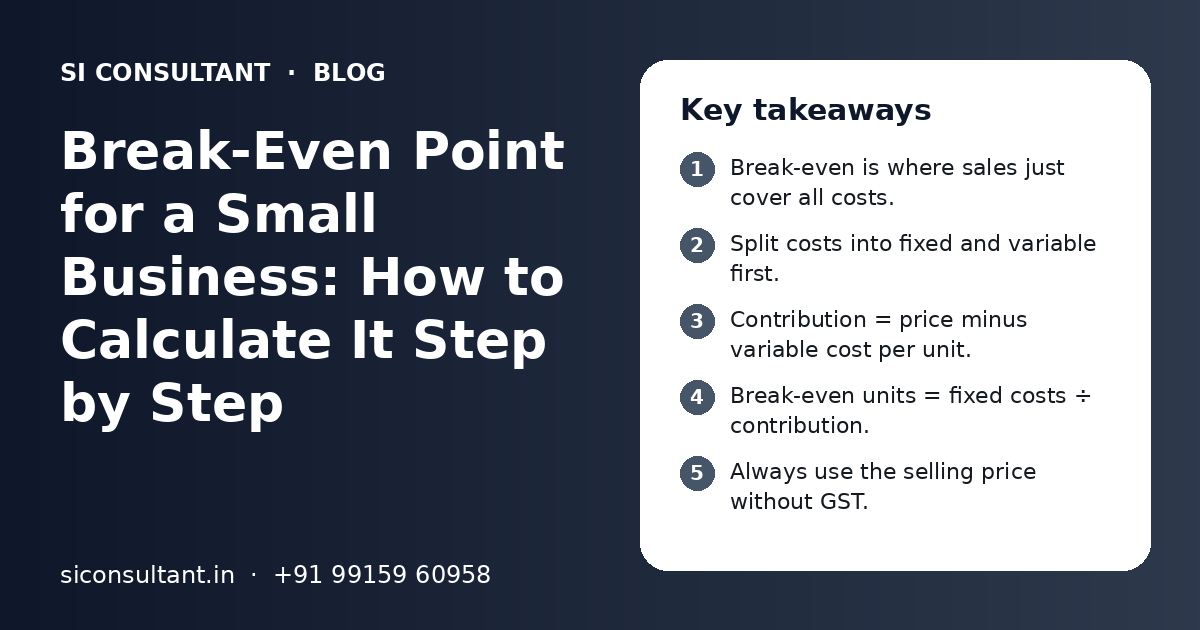
- Break-even is where sales just cover all costs.
- Split costs into fixed and variable first.
- Contribution = price minus variable cost per unit.
- Break-even units = fixed costs ÷ contribution.
- Always use the selling price without GST.
- Recheck break-even before price cuts or new hires.
What is the break-even point for a small business?
The break-even point is the level of sales where your income exactly covers all your costs. At this point you make no profit and no loss.
Knowing how to calculate break-even point for a small business helps you answer simple but important questions. How many customers do I need each day? Can I afford a new staff member? Is this discount a good idea? Is my new outlet worth opening?
You only need your cost numbers and a simple Excel or Google Sheet.
If you are still testing an idea, our guide on how to validate a business idea pairs well with this one. Break-even tells you whether the numbers can work.
What is the difference between fixed and variable costs?
Fixed costs stay about the same each month whether you sell a lot or a little. Variable costs go up and down with each unit you sell.
Get this split right, or your break-even number will be wrong.
| Cost | Fixed or variable? | Why |
|---|---|---|
| Shop or office rent | Fixed | Same amount every month |
| Salaries of permanent staff | Fixed | Paid even in a slow month |
| Owner's own monthly drawing | Fixed | You need it to live, so count it |
| Raw material or stock you buy to sell | Variable | More sales means more purchase |
| Packaging and delivery per order | Variable | Paid for each order |
| Payment gateway or marketplace fees | Variable | A cut of each sale |
| Electricity | Semi-variable | Has a base amount plus usage |
How to handle semi-variable costs
Some costs, like electricity, are mixed. Put the base part in fixed costs and the usage part in variable costs. Be consistent.
What is contribution margin and why does it matter?
Contribution margin is what is left from each sale after paying its variable cost. This amount goes towards paying your fixed costs, and then profit.
Think of your monthly fixed costs as a bucket. Each sale pours in its contribution. When the bucket is full, you break even. After that, it is profit.
A costly product with a high variable cost may fill the bucket slowly. A cheaper product with a low variable cost may fill it faster. So contribution matters more than price alone.
What is the break-even formula in units and in sales value?
Break-even in units is fixed costs divided by contribution per unit. Break-even in sales value is fixed costs divided by the contribution margin ratio.
| What you want | Formula | Best for |
|---|---|---|
| Break-even in units | Fixed costs ÷ (Price − Variable cost per unit) | A business with one main product or a clear average order |
| Break-even in sales value (₹) | Fixed costs ÷ Contribution margin ratio | A shop or business with many products |
| Sales needed for a profit target | (Fixed costs + Target profit) ÷ Contribution per unit | Setting monthly sales goals |
| Margin of safety | (Actual sales − Break-even sales) ÷ Actual sales | Seeing how much sales can fall before a loss |
Why GST must be left out
If you are registered under GST, the GST you collect from customers is not your income. You collect it on behalf of the government and pay it after adjusting input tax credit. So use your selling price before GST in every formula. If you add GST, your break-even will look lower than it really is.
In the same way, use purchase costs without the GST you can claim back as input credit. If you are under the composition scheme or not registered, ask your CA how to treat tax in your costs.
How do you calculate break-even point step by step?
List your fixed costs, find the variable cost and selling price per unit, work out the contribution, then divide. The whole process fits on one sheet.
- 1
List all fixed costs for one month
Include rent, salaries, the owner's drawing, loan interest, subscriptions and insurance. Turn yearly costs into a monthly figure.
- 2
Pick your unit
A unit can be one product, one plate, one order, one customer visit or one billable hour. Choose what makes sense for how you sell.
- 3
Find the selling price per unit without GST
Use the real average price after normal discounts, not the printed price.
- 4
Find the variable cost per unit
Add the cost of material, packaging, delivery, commission and payment fees for one unit.
- 5
Work out contribution per unit
Subtract the variable cost from the selling price.
- 6
Divide fixed costs by contribution
The answer is how many units you must sell each month to break even.
- 7
Turn it into a daily target
Divide the monthly units by the days you are open. A daily number is easier for your team to track.
Use an average of the last few months, not one month.
Need help with your project?
Talk to the SI Consultant team. Free first call, simple advice, clear quote.
What does a worked break-even example look like?
Here is a simple example for three kinds of business. All numbers are made up and rounded for easy maths. They are an example only and not a guide to real costs or prices.
Example 1: a small retail shop
Say a shop has fixed costs of ₹1,00,000 a month. Its average item sells for ₹500 without GST. The shop buys that item for ₹300, including packing. So each sale gives ₹200 as contribution.
Break-even units = ₹1,00,000 ÷ ₹200 = 500 items a month. The contribution margin ratio is ₹200 ÷ ₹500 = 0.4. So break-even sales value = ₹1,00,000 ÷ 0.4 = ₹2,50,000 a month. If the shop is open 25 days, it needs to sell about 20 items a day just to cover costs.
Example 2: a small restaurant
Say a restaurant has fixed costs of ₹3,60,000 a month. The average bill is ₹400 without GST. Food, packaging and payment fees for that bill come to ₹160. Contribution per bill is ₹240.
Break-even = ₹3,60,000 ÷ ₹240 = 1,500 bills a month. If it is open 30 days, that is 50 bills a day.
Example 3: a service business
Say a small design studio has fixed costs of ₹3,00,000 a month. It charges ₹2,000 per billable hour without GST. Freelancer cost and tools for that hour come to ₹500. Contribution per hour is ₹1,500.
Break-even = ₹3,00,000 ÷ ₹1,500 = 200 billable hours a month. The real question is whether the team can bill that many hours.
| Example only | Fixed costs / month | Contribution per unit | Break-even per month |
|---|---|---|---|
| Retail shop | ₹1,00,000 | ₹200 per item | 500 items |
| Restaurant | ₹3,60,000 | ₹240 per bill | 1,500 bills |
| Service studio | ₹3,00,000 | ₹1,500 per hour | 200 billable hours |
How can you use break-even for pricing and hiring decisions?
Break-even shows how much extra you must sell to pay for a price cut, a new hire or a new cost. Run the formula again before you decide.
Pricing and discounts
Take the shop example again. If the price drops by ₹50 to ₹450, contribution falls to ₹150. Break-even rises to ₹1,00,000 ÷ ₹150 = about 667 items. A small discount needs many more sales. If the price goes up by ₹50 to ₹550, contribution rises to ₹250 and break-even falls to 400 items.
A discount is never free. Before a festival sale, check how many extra units you need. Our pricing strategy consulting helps you test these choices before you change prices.
Hiring a new person
Say the shop hires one more staff member at ₹30,000 a month. Fixed costs rise to ₹1,30,000. Break-even becomes ₹1,30,000 ÷ ₹200 = 650 items. The new hire must help you sell at least 150 more items a month, or save that much cost elsewhere, to pay for themselves.
Break-even is good for
- Setting daily and monthly sales targets
- Testing a price change or discount
- Checking if a new hire or rent is affordable
- Planning a new outlet
Break-even does not tell you
- Whether customers will actually buy that much
- When cash will come in from credit sales
- Whether your price beats competitors
For bigger moves, like a second outlet or a new city, use break-even inside a wider plan. Our growth consulting and marketing budget planning work look at these numbers with demand and marketing costs.
How do you work out break-even when you sell many products?
When you sell many products, use the break-even sales value formula with an average contribution margin ratio. This gives one sales target in rupees for the whole business.
Take last month's total sales without GST, subtract total variable costs, and divide the result by total sales. That is your average ratio. Then divide fixed costs by it.
If your product mix changes, the ratio changes too. Selling more low-margin items pushes break-even up, even if total sales look the same. Check it every month, and track your top products by contribution, not only by sales.
What mistakes do owners make with break-even?
The most common mistakes are using prices with GST, leaving out the owner's salary, and treating break-even as a one-time number. Avoid these and your number will be much more useful.
- Do not include GST in the selling price
- Do not forget the owner's own salary or drawing
- Do not leave out yearly costs like insurance, renewals or audit fees
- Do not mix up profit with cash; credit sales may not be paid yet
- Do not forget loan EMIs if you want a cash break-even
- Do not calculate it once and forget it
On loans: interest is a cost, but the principal part of an EMI is not an expense in your profit and loss. You still pay it in cash, so add the full EMI to fixed costs for a cash break-even. If you are preparing for a loan, our guide on a business plan for a bank loan shows how banks look at these numbers.
When should you get help with break-even analysis?
Get help if you face a big decision, your costs are hard to split, or you are below break-even and not sure why.
SI Consultant helps Indian SME owners build a simple break-even sheet, check pricing and plan hiring and growth with clear numbers. We work alongside your CA, who handles tax and accounts. See our business consulting service for how we work.
SI Consultant is powered by Shivah Web Tech, with 11+ years of experience and 500+ projects. We work Monday to Friday, 9:30 to 6:30 IST, from Mohali. Contact us for a free first call and a clear quote.
Frequently Asked Questions
What is the simple formula for break-even point?
The simple formula is fixed costs divided by contribution per unit. Contribution per unit is the selling price without GST minus the variable cost per unit. The answer is the number of units you must sell to cover all costs. To get the answer in rupees, divide fixed costs by the contribution margin ratio instead.
Should I include GST when I calculate break-even?
No. If you are GST registered, the GST you collect belongs to the government, not to your business. Use your selling price before GST and your purchase costs without the input tax credit you can claim. Including GST makes your break-even look lower than it really is. If you are under the composition scheme, ask your CA.
How often should a small business calculate its break-even point?
Check it at least every quarter, and every month if your costs or prices change often. Also recalculate it before any big decision, such as a price change, a festival discount, a new hire, a new outlet or a rent increase. A break-even number that is a year old can give you the wrong answer.
What is the margin of safety and why does it matter?
Margin of safety shows how far your sales can fall before you make a loss. Subtract break-even sales from actual sales, then divide by actual sales. For example, if you sell 700 units and break even at 500, your margin of safety is 200 units. A bigger margin means your business can handle a slow month better.
Can a service business with no products use break-even?
Yes. Use time or projects as the unit. For example, take the fee per billable hour without GST, subtract the direct cost of that hour, and divide your monthly fixed costs by the result. This tells you how many billable hours you need each month. It also shows whether your team has enough capacity.
What if my business is below break-even?
First check your numbers are right. Then look at three levers: raise prices where customers value you, lower variable costs through better buying or less waste, and cut fixed costs you do not need. Selling more only helps if each sale has a healthy contribution. If losses continue, get outside advice early, before cash runs low.
Is break-even the same as profit?
No. At break-even, profit is zero. You have covered all costs but earned nothing extra. Profit only starts after break-even. Also, break-even is not the same as cash in hand. If customers buy on credit, you may be above break-even on paper but still short of cash until they pay you.