Quick answer
What affects the cost of hiring a business consultant?
The main business consultant cost factors are the scope of the problem, how long the work runs, how deep the audit goes, the fee model (hourly, project or retainer), on-site or remote work, and whether the consultant also helps you put the plan into action. Clear goals and ready data usually lower the cost.
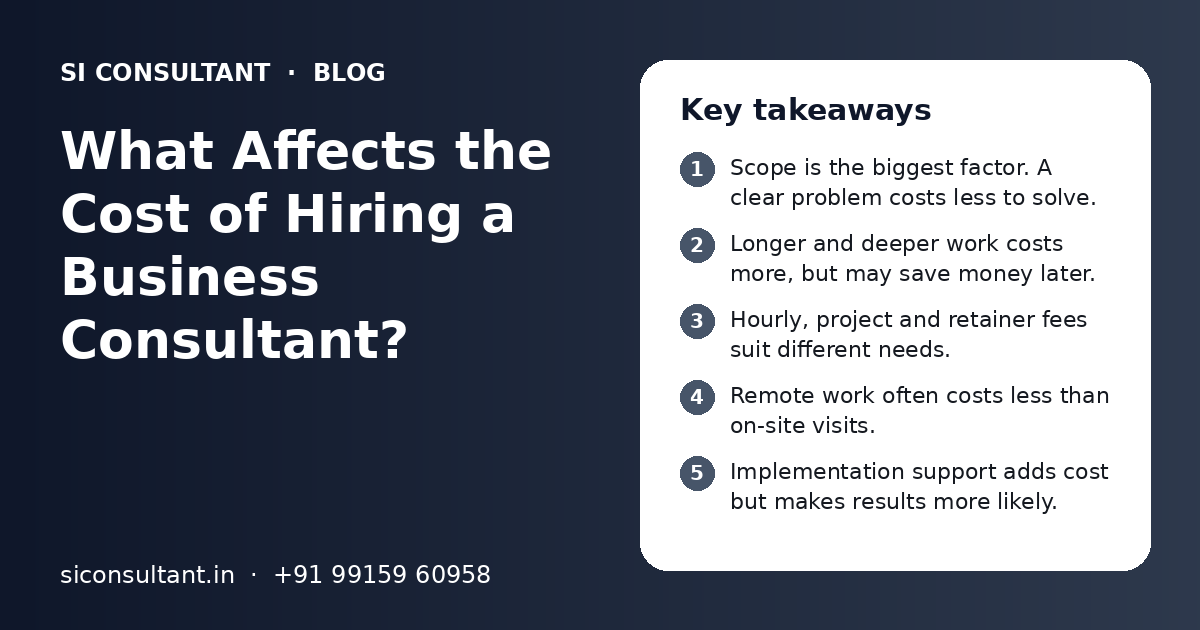
Key takeaways
- Scope is the biggest factor. A clear problem costs less to solve.
- Longer and deeper work costs more, but may save money later.
- Hourly, project and retainer fees suit different needs.
- Remote work often costs less than on-site visits.
- Implementation support adds cost but makes results more likely.
- Ready data and one decision-maker cut wasted hours.
What are the main business consultant cost factors?
The main business consultant cost factors are scope, duration, depth of audit, fee model, location of work and implementation support. Each one changes how much time and skill the consultant must put in, and time and skill are what you pay for.
Many owners ask "what is the price?" before the scope is clear. That is like asking a builder the cost of a house before you choose the size. A good consultant will first ask questions, then give a quote. At SI Consultant, you get a clear quote after a free call.
| Cost factor | Lower cost when | Higher cost when |
|---|---|---|
| Scope | One clear problem, such as pricing or a sales process | Many areas at once: sales, marketing, operations and tech |
| Duration | A short project with a fixed end | Many months of ongoing advice |
| Depth of audit | A quick review of key numbers | A detailed audit of data, systems and teams |
| Fee model | A small fixed project or a few hours | A long retainer with many meetings |
| Location | Remote calls and shared documents | Regular on-site visits and travel |
| Implementation | Advice only, your team does the work | Consultant helps run the changes |
| Your readiness | Data is ready and one person decides | Data is scattered and many people must agree |
How does scope change the cost of a consultant?
Scope is the biggest cost factor. A narrow, well-defined problem takes fewer hours to study and solve. A broad request like "help us grow" needs more discovery, more meetings and more output, so it costs more.
Scope covers what the consultant will study, deliver and leave out. Write it down before work starts.
Examples of narrow and broad scope
- Narrow: review our pricing for three main products and suggest new price levels.
- Narrow: map our sales process and fix where leads are being lost.
- Medium: build a yearly marketing plan and budget for one city.
- Broad: review the whole business and build a growth roadmap for all teams.
A broad scope is not wrong. Some businesses need a full review. But if your budget is tight, start with the one problem that hurts most. Our post on when to hire a business consultant helps you name that problem.
How do duration and depth of audit affect the fee?
Longer projects and deeper audits cost more because they need more expert hours. A quick health check looks at a few key numbers. A deep audit reads data, systems, processes and team roles in detail and talks to several people.
The right depth depends on the decision you face. A small decision needs a light review. A big decision, such as entering a new market or changing your software, needs a deeper look.
| Audit depth | What it usually covers | Good for |
|---|---|---|
| Quick review | Key numbers, a short owner interview, top issues | Getting a first view before a bigger project |
| Standard audit | Sales, marketing and operations data, team interviews, a written report | Most SMEs that want a clear action list |
| Deep audit | Detailed data study, process mapping, system review, many interviews | Big decisions, larger teams or complex businesses |
For example, a website audit can be a short check of speed and leads, or a deep review of every page, form and tracking setup. The depth you choose changes the effort and the fee.
Duration also matters. A four-week project with a fixed end is easy to budget. Ongoing work over many months costs more in total, but spreads the cost and gives you steady support.
Hourly vs project vs retainer: which fee model is right?
Hourly fees suit small, one-off questions. Project fees suit a clear task with a defined output. A retainer suits ongoing advice over several months. The best model is the one that matches how you will use the consultant.
| Fee model | How it works | Best for | Watch out for |
|---|---|---|---|
| Hourly | You pay for the time used | Quick advice, a second opinion, a short review | Hours can add up if the task is not clear |
| Project | One fixed fee for an agreed scope and output | Audits, plans, roadmaps, vendor selection | Extra work outside scope may cost more |
| Retainer | A set monthly fee for agreed time or support | Ongoing advice, monthly reviews, part-time leadership | Paying for months where you do not use the time |
Why a project fee helps SMEs
- You know the cost before work starts
- The output is written down
- Easy to compare quotes from different consultants
When a project fee is harder
- The problem is not yet clear
- Needs change every week
- You need someone on call for many months
Part-time leadership roles, such as a fractional CMO or a fractional CTO, usually work on a retainer. A one-time plan, such as marketing budget planning, usually works best as a fixed project.
Does on-site or remote consulting cost more?
On-site consulting usually costs more than remote consulting because it adds travel time and travel expenses. Remote work over video calls, WhatsApp and shared documents is often enough for strategy, audits and planning.
On-site visits are still useful in some cases. A consultant may need to see a factory floor, a shop layout, a warehouse or how a team works day to day.
When on-site visits are worth it
- Process mapping in a factory, kitchen or warehouse
- Workshops with a large team or family partners
- Problems that depend on the physical space, such as store layout
- Kick-off meetings where trust needs to be built face to face
When remote work is enough
- Reviewing sales and marketing numbers
- Building plans, budgets and roadmaps
- Software and vendor selection
- Monthly review calls
A mix works well for many SMEs: one or two visits at key moments, and the rest remote. SI Consultant is based in Mohali, and serves clients across India and in the USA, UK, Canada, UAE and Australia, mostly through remote work.
Need help with your project?
Talk to the SI Consultant team. Free first call, simple advice, clear quote.
Should you pay extra for implementation support?
Implementation support costs more than advice alone, but it often decides whether the plan works. If your team is busy or lacks the skills, a consultant who helps put changes in place can save time and avoid mistakes.
Many plans fail not because the advice was wrong, but because no one had time to act on it. Think about who will do the work after the report is handed over.
| Support level | What you get | Who it suits |
|---|---|---|
| Advice only | Audit, report and action list | Teams with time and skills to act alone |
| Advice plus check-ins | Report plus short follow-up calls to review progress | Teams that need a little guidance |
| Hands-on support | Consultant helps set up processes, tools, hiring or vendors | Busy owners or teams new to the work |
Our business consulting work can include follow-up reviews, so the plan turns into weekly habits and not just a document.
What else changes a consultant's quote?
Other factors that change a quote include the consultant's experience, the size of your business, how ready your data is, how many people must approve decisions, and how urgent the work is.
- Experience: a senior expert may cost more per hour but finish faster and avoid costly errors.
- Business size: more branches, products and staff mean more to study.
- Data readiness: if sales and cost data is scattered in notebooks and WhatsApp, time goes into collecting it.
- Decision-makers: when many partners must agree, more meetings are needed.
- Urgency: a rushed deadline may need extra hours in a short time.
- Language and reports: reports in more than one language, or for a bank or investor, take extra effort.
Taxes also apply. In India, consulting services generally carry GST, so check whether a quote includes or excludes GST before you compare it with another.
How can you get the most value from a business consultant?
You get the most value by naming one clear goal, preparing your data before the first meeting, choosing one decision-maker, agreeing the scope and output in writing, and starting with a small first project.
- 1
Name the problem
Write the one problem or decision in two or three lines, such as "our leads are high but sales are low".
- 2
Gather your numbers
Collect monthly sales, costs, leads and team details for the last year, even in a simple sheet.
- 3
Pick one decision-maker
One person should approve the scope, answer questions and sign off on the output.
- 4
Agree scope in writing
List what is included, what is not, the output, the timeline and how extra work is handled.
- 5
Start small
Begin with an audit or a short project. Extend only if the first step is useful.
- 6
Act on the plan
Set owners and dates for each action, and review progress every month.
- Does the quote list the exact output you will receive?
- Is the timeline clear, with dates for key steps?
- Is it clear who from the consultant's side will do the work?
- Does the quote say how extra work will be priced?
- Is GST shown clearly?
- Can you start with a smaller first phase?
What mistakes push consulting costs up?
The mistakes that push consulting costs up are unclear goals, changing the scope often, slow replies, missing data, too many decision-makers and choosing a consultant only on the lowest fee.
- Starting without a clear goal, so the first weeks go into guessing.
- Adding new tasks in every call without updating the scope.
- Taking weeks to share data or answer questions.
- Letting several partners give different instructions.
- Picking the cheapest quote that leaves out the work you actually need.
- Paying for a report and then not acting on it.
Price alone is a poor guide. Compare what each quote includes and how clear the output is.
How does SI Consultant price its work?
SI Consultant prices work after a free first call, based on your scope, the depth needed, the time involved and how much hands-on support you want. You get a clear written quote before any work starts.
We are powered by Shivah Web Tech, with 11+ years of experience, a 25+ in-house team and 500+ projects. We work Monday to Friday, 9:30 to 6:30 IST. Whether you need growth consulting, a digital strategy or help with one decision, we keep the scope clear and the advice simple. Contact us to book your free call.
Frequently Asked Questions
How much does a business consultant cost in India?
There is no single price. The cost depends on scope, duration, audit depth, the fee model, on-site or remote work and implementation support. A short review of one problem costs much less than a full business review with hands-on help. The best way to know is to share your goal on a free call and ask for a written quote.
Is hourly or project pricing better for a small business?
For most small businesses, project pricing is easier because you know the cost and the output before work starts. Hourly pricing suits short questions or a second opinion. If you need steady advice over several months, a retainer may suit you better. Choose the model that matches how you will use the consultant.
What is a consulting retainer?
A consulting retainer is a set monthly fee for agreed advice or time, such as weekly calls, monthly reviews or part-time leadership. It suits ongoing needs where questions come up often. Check how many hours or meetings are included, what happens to unused time and how you can end the retainer if your needs change.
Why do consultant quotes differ so much?
Quotes differ because consultants may include different scope, depth, support and experience. One quote may cover a quick review, while another covers a deep audit with follow-up help. Some include GST and some do not. Compare the output, timeline, who will do the work and what is left out, not just the final number.
Is remote business consulting as good as on-site?
For strategy, audits, plans, budgets and software selection, remote consulting usually works well and often costs less. On-site visits help when the consultant must see physical work, such as a factory, kitchen, store or warehouse, or run a large workshop. Many businesses use a mix of a few visits and regular remote calls.
How can I lower the cost of a business consultant?
Keep the scope narrow, prepare your data before work starts, choose one decision-maker, reply quickly and avoid adding tasks without updating the scope. Start with a small audit or first project, and let your own team do the work the consultant does not need to do. These steps cut wasted hours.
Is a business consultant worth the money for an SME?
A consultant is worth it when the problem is clear and the cost of not fixing it is high, such as falling margins, lost leads or a costly software decision. Value comes from acting on the advice. If you are not ready to make changes, wait. A small first project is a safe way to test the value.
Do consulting fees in India include GST?
Consulting services in India generally attract GST. Some quotes show the fee before GST and some show the total. Always ask whether GST is included so you compare quotes fairly. If your business is GST registered, ask your accountant whether you can claim input tax credit on the consulting fee.