Quick answer
Franchise vs company-owned outlets: which is better for an Indian SME?
In the franchise vs company-owned outlets choice, franchising lets you grow faster with less of your own money, but you give up some control over quality and customer experience. Company-owned outlets need more capital and management time, but you keep full control and all the profit. Many SMEs open a few own outlets first, then franchise.
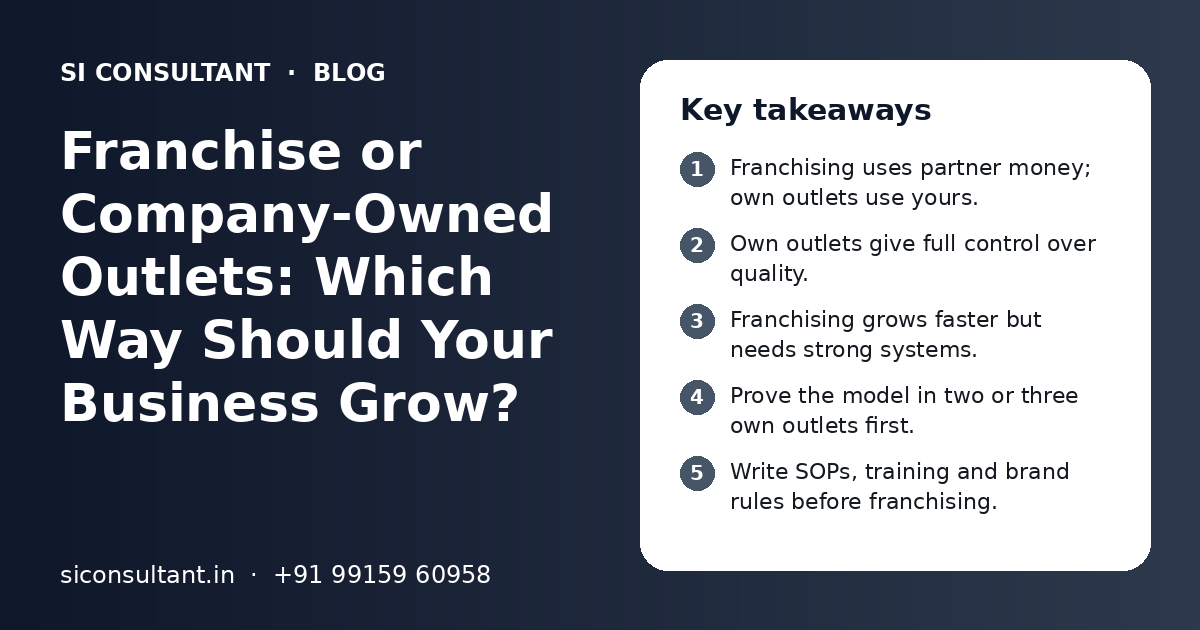
Key takeaways
- Franchising uses partner money; own outlets use yours.
- Own outlets give full control over quality.
- Franchising grows faster but needs strong systems.
- Prove the model in two or three own outlets first.
- Write SOPs, training and brand rules before franchising.
- Get a lawyer and CA to check every agreement.
What is the difference between franchise and company-owned outlets?
With company-owned outlets, your business pays for, runs and earns from every branch. With a franchise, a local partner pays to open and run an outlet under your brand and system, and shares part of the income with you.
| Point | Company-owned outlets | Franchise outlets |
|---|---|---|
| Who invests | You | Mostly the franchisee |
| Who runs daily work | Your staff | The franchisee and their staff |
| Speed of growth | Slower, limited by your cash and managers | Faster, if partners are found |
| Control over quality | Full | Shared, depends on agreement and checks |
| Profit per outlet | Full outlet profit | Fees and a share of sales |
| Main risk | Your money is at risk if an outlet fails | Your brand is at risk if a partner fails |
| Systems needed | Good internal systems | Very strong, written and teachable systems |
Neither model is right for everyone. The better choice depends on your cash, your systems, your product and how much control your brand needs.
Which model needs less capital and grows faster?
Franchising usually needs less of your own capital and can grow faster, because partners pay for the outlet. Company-owned outlets grow at the speed of your cash, loans and the managers you can hire.
With own outlets, you pay for rent, deposits, interiors, equipment, stock and salaries before the first sale. Each new branch also needs a manager you trust. For many Indian SMEs, this means opening one or two branches a year at most.
Franchising moves most of these costs to the partner. But it is not free for you. You still need to spend on:
- Writing SOPs, recipes, service scripts and training material
- A team to find, check and train franchise partners
- Field visits and audits to check quality
- Supply chain, so every outlet gets the same products or materials
- Legal work on agreements and brand protection
- Software for billing, stock and reporting across outlets
If you are unsure where growth should come from first, our growth consulting helps you compare new outlets with other options, such as online sales or new products.
Which model gives better control over quality and customer experience?
Company-owned outlets give you much better control, because the staff work for you and follow your rules directly. In a franchise, you can only control what the agreement, training and audits allow.
Customers do not care who owns the outlet. If one franchise serves cold food or rude service, people blame your brand, and they say so on Google reviews and social media.
| Control area | Company-owned | Franchise |
|---|---|---|
| Hiring and firing staff | You decide | Franchisee decides |
| Pricing and discounts | You decide | Set in agreement, harder to enforce |
| Product and recipe quality | Direct checks every day | Training, audits and supply rules |
| Local marketing | Your team runs it | Shared, needs brand guidelines |
| Customer data | Fully with you | Depends on the agreement and the software used |
| Changing the menu or service | Quick | Needs partner buy-in and retraining |
If your business depends on a skilled person, such as a doctor, chef or trainer, control matters even more. Clear written processes, which our business consulting work helps build, are the base for either model.
What are the pros and cons of franchising for an Indian SME?
Franchising helps you reach many cities quickly with local partners who know the market. The main risks are weak partners, quality problems and disputes that can hurt your brand.
Benefits of franchising
- Faster spread to new cities and towns
- Less of your own money tied up in each outlet
- Local partners know the area, language and customers
- Owner-run outlets often have motivated managers
- Steady fee and share income if outlets do well
Risks of franchising
- Less control over daily service and quality
- One bad outlet can damage the whole brand
- Partner disputes can be slow and costly
- You earn only a share, not full outlet profit
- Needs a strong head office team for support and audits
Franchising works best for simple, repeatable formats, such as food outlets, retail stores, salons, coaching centres and service kiosks, where the same steps can be taught to anyone.
Need help with your project?
Talk to the SI Consultant team. Free first call, simple advice, clear quote.
What are the pros and cons of company-owned outlets?
Company-owned outlets give full control and full profit, and they let you learn quickly. The main limits are high capital needs, slower growth and the strain of managing many branches.
Benefits of own outlets
- Full control over quality, pricing and customer experience
- All outlet profit stays with you
- Easier to test new products or services
- Customer data and staff stay with the company
- Fewer legal agreements with outside partners
Limits of own outlets
- High upfront cost for every branch
- Growth limited by cash and good managers
- You carry the full loss if an outlet fails
- Owner time gets stretched across cities
- More staff to hire, train and pay
Own outlets suit high-value services, premium brands, and businesses where trust or skill is the main product. They are also the right first step before franchising.
Is your business ready to franchise?
Your business is ready to franchise when your outlets make steady profit, your work is written down so others can repeat it, and your brand is protected. If these are missing, open your own branches first.
- At least two or three outlets run profitably without the owner present daily
- You know the full cost and profit of running one outlet
- SOPs cover opening, closing, service, hygiene, stock and complaints
- A training plan can teach a new team in a few weeks
- A steady supply chain can serve outlets in other cities
- Your brand name and logo are registered as trademarks, or the application is filed
- Billing and reporting software shows sales from every outlet
- You have a team, not just the owner, to support partners
- Your pricing leaves enough margin for both you and the franchisee
The margin point is often missed. If one outlet barely makes money for you, it will not make enough for a franchisee after paying fees. Our pricing strategy consulting helps check this early. For more warning signs, read our post on mistakes to avoid when scaling a small business.
Can you mix franchise and company-owned outlets?
Yes. Many brands in India use a mix: own outlets in the home city and key markets, and franchise outlets in other cities. You will often hear the terms COCO, FOCO and FOFO for these setups.
| Model | Who invests | Who runs it | Good for |
|---|---|---|---|
| COCO (company owned, company operated) | Company | Company | Flagship stores, home city, testing |
| FOCO (franchise owned, company operated) | Franchisee | Company team | Partners with money but no time or skill |
| FOFO (franchise owned, franchise operated) | Franchisee | Franchisee | Fast spread with strong systems |
A common path is to start with COCO outlets to prove the model, try a few FOCO or FOFO outlets in nearby cities, and grow franchising only when these work. Exact terms and fee structures vary, so check every agreement with a lawyer and a CA.
How should an SME plan its first expansion step?
Plan one clear step at a time: fix the base, choose the model, test in one new location, review the numbers, then grow. Do not sign many franchise partners at once.
- 1
Review your current outlet
Check monthly sales, costs, margin and how much depends on the owner. Fix weak areas first.
- 2
Write down the system
Turn daily work into SOPs, checklists and training material that a new team can follow.
- 3
Choose the model
Compare cash, control and speed. Decide between own outlets, franchise or a mix for the next one or two years.
- 4
Pick the first location
Study the new city or area, customer habits, rent and competition. Our go-to-market strategy work helps here.
- 5
Set up tools
Put billing, stock and reporting software in place so you can see every outlet's numbers. A CRM helps track franchise enquiries and customers.
- 6
Get legal and tax advice
Ask a lawyer to draft or check agreements and trademark protection, and a CA to explain GST and accounting for fees and royalties.
- 7
Open, review and adjust
Run the new outlet for a few months, compare it with the first one, fix gaps, then decide on the next step.
How can SI Consultant help you choose the right expansion model?
SI Consultant helps you check if your business is ready to expand, compare franchise and own outlet models with your real numbers, and build the SOPs, tools and plan you need for either path.
We work with you, not around you, and we tell you honestly if the base needs fixing first. We also work with your lawyer and CA on the parts that need them. SI Consultant is powered by Shivah Web Tech, with 11+ years of experience, a 25+ member in-house team and 500+ projects. You get a clear quote after a free call. Contact us to start.
Frequently Asked Questions
Should I franchise my business or open my own branches first?
Most small businesses should open one to three of their own branches first. This proves that the model works in more than one place and helps you write down the system. Once own outlets run well without daily owner involvement, franchising becomes much safer. Franchising too early often spreads problems faster than profits.
Is franchising cheaper than opening company-owned outlets?
For you, franchising usually needs less capital per outlet, because the partner pays for setup. But it is not free. You must invest in SOPs, training, a support team, audits, supply chain, software and legal work. If these are weak, low upfront cost can turn into high brand and dispute costs later.
What does COCO, FOCO and FOFO mean?
These are common terms in Indian retail and food businesses. COCO means company owned, company operated. FOCO means franchise owned, company operated, where a partner invests but your team runs the outlet. FOFO means franchise owned, franchise operated, where the partner both invests and runs it. Each mixes control and capital differently.
How many outlets should I have before franchising?
There is no fixed number, but having two or three profitable outlets, ideally in different areas, is a sensible starting point. What matters more is proof that outlets can run well without the owner, clear unit numbers, written SOPs, a working supply chain and a protected brand name.
Do I need a lawyer to start franchising in India?
Yes, you should work with a lawyer. A franchise agreement covers fees, territory, brand use, quality rules, duration, exit terms and disputes. A lawyer can also help with trademark registration. Also speak to a CA about GST, invoicing and accounting for franchise fees and royalties. Do not copy an agreement from the internet.
What kind of businesses are good for franchising?
Businesses with simple, repeatable formats suit franchising best, such as food outlets, retail stores, salons, coaching centres, fitness studios and service kiosks. If your results depend on one rare skill or on the owner's personal touch, franchising is harder. In that case, own outlets or a hybrid model may work better.
Can a franchise hurt my brand?
Yes. Customers see one brand, not separate owners. Poor service, hygiene or pricing at one franchise outlet can lead to bad reviews that affect every outlet. You reduce this risk with careful partner selection, strong training, clear brand rules, regular audits and an agreement that lets you act when standards are not met.