Quick answer
What mistakes should you avoid when scaling a small business?
The main mistakes to avoid when scaling a small business are growing before the core offer is steady, running out of cash, keeping every decision with the owner, hiring in a rush, skipping written processes and tools, and chasing too many markets at once. Fix these basics first, then grow step by step.
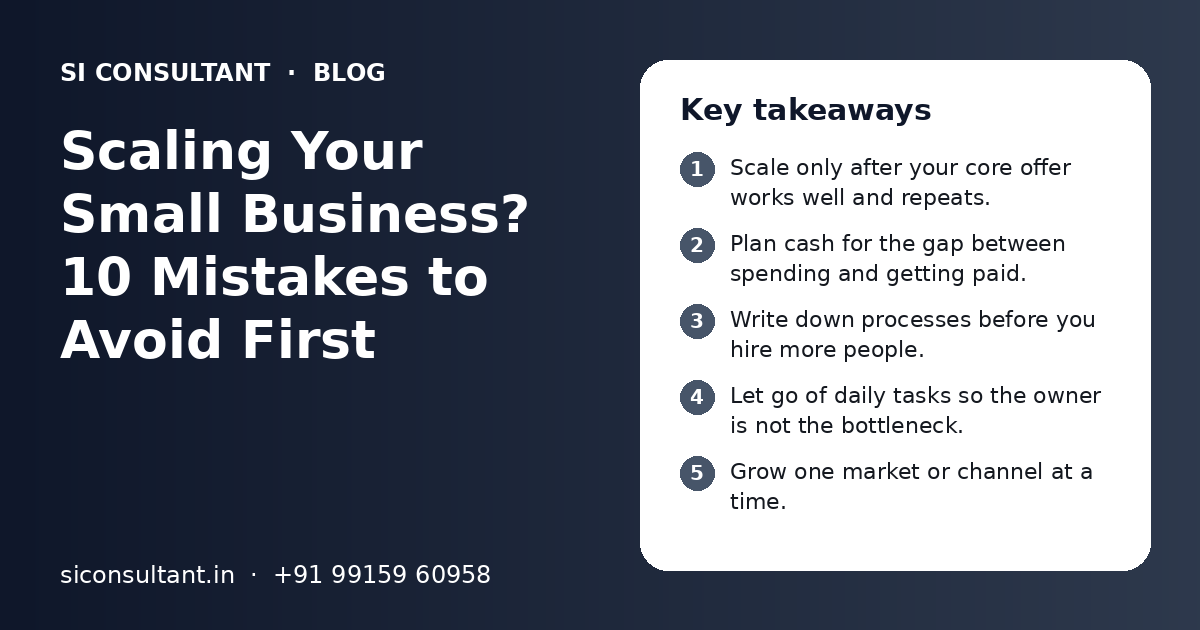
Key takeaways
- Scale only after your core offer works well and repeats.
- Plan cash for the gap between spending and getting paid.
- Write down processes before you hire more people.
- Let go of daily tasks so the owner is not the bottleneck.
- Grow one market or channel at a time.
- Track a few clear numbers every month.
What does scaling a small business really mean?
Scaling means growing sales without costs, effort and problems growing at the same speed. Many owners grow by working harder, but true scaling needs systems, people and cash planning in place first.
Growth and scaling are not the same. A business can double its orders and still struggle. Deliveries get late, quality slips, staff feel lost and the owner works late every night. That is growth without scaling.
Most mistakes to avoid when scaling a small business come from moving too fast on sales while the back end stays the same. The sections below cover the most common ones we see in Indian SMEs, and how to avoid them. If you want a guided view of your own business, our growth consulting starts with exactly this kind of review.
How do you know if your business is ready to scale?
Your business is ready to scale when customers buy again and refer others, your margins are healthy, the work can be done without you on every task, and you have cash or funding for the growth phase.
| Sign | Ready to scale | Not ready yet |
|---|---|---|
| Demand | Steady orders and repeat buyers | Sales go up and down a lot |
| Margins | You know your profit on each product or service | You are not sure which items make money |
| Owner time | Team handles daily work without you | Everything waits for the owner |
| Processes | Key steps are written down | Work lives in people's heads |
| Cash | A buffer for slow payments and new costs | Every month is tight |
| Numbers | Monthly sales, costs and collections are tracked | Accounts are seen only at GST or year-end time |
If you are in the right column on most rows, it is not a bad thing. It just means your next step is to fix the base, not to push sales harder.
Mistake 1 and 2: Scaling before the offer is steady, and ignoring cash flow
Do not scale a product or service that still changes every month, and do not grow without a cash plan. Both mistakes can sink a business that looks busy and successful from the outside.
Mistake 1: Scaling an offer that is not proven
If customers still ask for many changes, return items often or need a lot of hand-holding, the offer is not ready. More sales will only bring more of the same problems. First fix the offer, the delivery and the price, then grow. Our pricing strategy consulting helps when you are not sure your prices leave enough margin to grow.
Mistake 2: Running out of cash while growing
Growth usually needs money before it brings money. You buy more stock, hire staff, pay for ads and give credit to bigger buyers. Many B2B buyers in India pay weeks or months after the invoice. During that gap, you still pay salaries, rent and GST on time.
- Make a simple month-by-month cash plan for the next 6 to 12 months
- Know how many days, on average, your customers take to pay
- Agree clear payment terms and follow up on dues every week
- Keep a cash buffer before you sign big new costs
- Talk to your bank and CA early if you may need working capital
Mistake 3 and 4: The owner stays the bottleneck, and processes stay in people's heads
If every decision and approval still goes through the owner, the business cannot grow beyond the owner's time. And if steps are not written down, each new hire learns by trial and error.
Mistake 3: The owner does everything
In many family businesses and startups, the owner handles sales, pricing, buying, payments and customer complaints. This works with ten customers. It breaks with a hundred. Start by listing your weekly tasks. Mark the ones only you can do. Hand over the rest to a trusted person, with clear limits on what they can decide.
Mistake 4: No written processes
A process can be a one-page note, a short video or a simple checklist. Write down how you take an order, how you deliver, how you bill, and how you handle a complaint. Use simple language, and the local language where your team prefers it.
- 1
Pick the five most repeated tasks
For example, quoting, order entry, dispatch, billing and payment follow-up.
- 2
Ask the person who does it best to explain it
Record the steps as they do them, in their own words.
- 3
Turn it into a short checklist
Keep it to one page. Add who does what and by when.
- 4
Test it with a new or junior person
See where they get stuck and fix those steps.
- 5
Review it every few months
Update the checklist when tools, prices or customers change.
Once processes are clear, many steps can be automated. Our automation consulting helps you choose which ones to automate first.
Need help with your project?
Talk to the SI Consultant team. Free first call, simple advice, clear quote.
Mistake 5 and 6: Hiring in a rush, and the wrong tools
Hiring fast to keep up with orders often brings the wrong people into the wrong roles. And running a bigger business on notebooks, WhatsApp chats and many unlinked spreadsheets leads to missed orders and lost data.
Mistake 5: Hiring before roles are clear
Before you hire, write what the role must achieve in the first three months. Decide who will train the person and how you will check their work. A clear role and a short onboarding plan matter more than hiring many people at once.
Mistake 6: Growing on scattered tools
WhatsApp is great for talking to customers. It is a poor place to store orders, leads and payment records. As you grow, you usually need a simple CRM for leads and a proper system for stock, billing and accounts.
| Area | Early stage | When scaling |
|---|---|---|
| Leads and follow-up | Phone, WhatsApp, notebook | A simple CRM with reminders |
| Billing and GST | Basic billing app | Accounting software linked to stock |
| Stock and orders | Spreadsheet | Inventory or ERP system |
| Team tasks | WhatsApp groups | A shared task tool with owners and dates |
| Reports | Owner's memory | A monthly dashboard of key numbers |
Do not buy the biggest software you can find. Pick tools that match your size and can grow with you. Our CRM selection consulting and ERP selection consulting help you choose without overspending.
Mistake 7 and 8: Chasing too many markets, and spending on marketing without a plan
Trying a new city, a new product, a marketplace and an export market all at once spreads your team and cash too thin. And raising the marketing spend without knowing what works usually wastes money.
Mistake 7: Too many new markets at once
Each new market brings new costs, new rules and new customer habits. A new state can mean a separate GST registration and new logistics partners. Selling on marketplaces brings new fees and return rules. Pick one new market or channel, make it work, then add the next.
Mistake 8: Spending more on ads without tracking
When sales are good, owners often add more ad spend, more agencies and more platforms. Without tracking leads and sales by source, you cannot tell what is working. Set a monthly marketing budget, track cost per lead and cost per sale, and move money to what brings real buyers. A clear marketing budget plan makes this much easier.
Focused growth
- One new market or channel at a time
- Clear budget and goal for each test
- Lessons carried into the next step
Scattered growth
- Many launches in the same quarter
- No one owns each new market
- Cash and team stretched thin
Mistake 9 and 10: Ignoring existing customers, and not tracking numbers
Chasing new customers while old ones are unhappy is a costly mistake. So is growing without a few clear numbers that show whether the business is getting healthier or only busier.
Mistake 9: Forgetting current customers
During fast growth, service often slips for loyal customers. They wait longer for replies and deliveries. Some leave quietly. Keep a simple check: call a few regular customers every month, ask what is going well and what is not, and fix the common complaints first.
Mistake 10: No monthly scorecard
You do not need a complex report. A one-page monthly scorecard is enough to start.
- Sales this month and the same month last year
- Gross margin by main product or service
- Money owed by customers and how old it is
- Cash in the bank and expected cash next month
- New leads, conversion rate and repeat customers
- Customer complaints and delivery delays
Our sales process consulting helps you set up clear stages and numbers for your sales team, so the scorecard has real data behind it.
What is a simple checklist before you scale?
Before you push for faster growth, check that your offer, cash, team, processes, tools and numbers are in place. Use the checklist below and fix any gaps first.
- Our core product or service sells steadily and customers come back
- We know our margin on each main product or service
- We have a cash plan for the next 6 to 12 months
- Key tasks are written as simple checklists
- The owner is not needed for daily approvals
- Each new role has clear goals and a training plan
- Leads, orders, stock and billing are in proper tools
- We will open one new market or channel at a time
- Marketing spend is tracked by source
- We review a one-page scorecard every month
For a step-by-step plan after this checklist, see our 90-day growth plan for small business.
How can SI Consultant help you scale without these mistakes?
SI Consultant reviews your business, finds the gaps that will break first when you grow, and gives you a clear, step-by-step roadmap. We focus on practical fixes, not long reports.
A typical engagement covers your offer and margins, cash planning, owner workload, processes, tools and marketing spend. You get a written plan with clear priorities. Our business consulting service also helps you put the plan into action.
SI Consultant is backed by Shivah Web Tech, with 11+ years of experience, a 25+ member in-house team and 500+ projects. We work from Mohali, Monday to Friday, 9:30 to 6:30 IST, and serve clients across India and abroad. The scope depends on your size and goals, so you get a clear quote after a free call. Contact us to book your first call.
Frequently Asked Questions
What is the biggest mistake when scaling a small business?
The most common mistake is growing sales before the base is ready. This includes an offer that still changes often, no cash plan and an owner who handles every decision. When orders grow, these gaps show up as late deliveries, unhappy customers and cash stress. Fixing the base first makes growth calmer and more profitable.
How do I know if I am growing too fast?
Warning signs include late deliveries, more complaints, staff working late all the time, unpaid dues piling up and the owner feeling stuck in daily work. If cash gets tighter even as sales rise, you may be growing faster than your systems and cash can handle. Slow down new sales pushes and fix the base before the next push.
Should I take a loan to scale my business?
A loan can help if you have a clear plan for how the money will bring returns and how you will repay it. Make a simple cash plan first, and talk to your bank and your CA about working capital options. Avoid borrowing to cover losses from an offer that does not yet make money, because that only grows the problem.
When should I hire a manager for my small business?
Hire a manager when the owner spends most of the day on routine tasks and has no time for planning, sales or key customers. Before hiring, write down the processes the manager will run and what they can decide on their own. A manager with clear goals and limits frees the owner without losing control.
Do I need an ERP or CRM to scale?
Not on day one, but most growing businesses need proper tools at some point. A CRM helps you track leads and follow-ups, and an ERP or inventory system helps with stock, orders and billing. Choose software that fits your current size and can grow with you. Get your processes clear first, so the tool supports how you work.
Is it better to grow in one city first or go national?
For most small businesses, it is safer to do well in one city or region first. You learn what customers want, fix delivery and build cash. Then you can repeat the model in the next city with less risk. Going national at once brings many new costs and rules together, which can stretch a small team.
Can a consultant help a small business scale?
Yes, a good consultant brings an outside view and a clear structure. They help you see gaps you may have stopped noticing, set priorities and build a step-by-step plan. The real work is still done by you and your team. Choose a consultant who explains things simply and focuses on practical actions, not just reports.