Quick answer
How do you set yearly business goals for a small business?
To set yearly business goals for a small business, first review last year's numbers, then pick two or three goals that matter most, such as sales, profit or new customers. Break each goal into quarterly and monthly targets, give each one an owner, and check progress in a short weekly review.
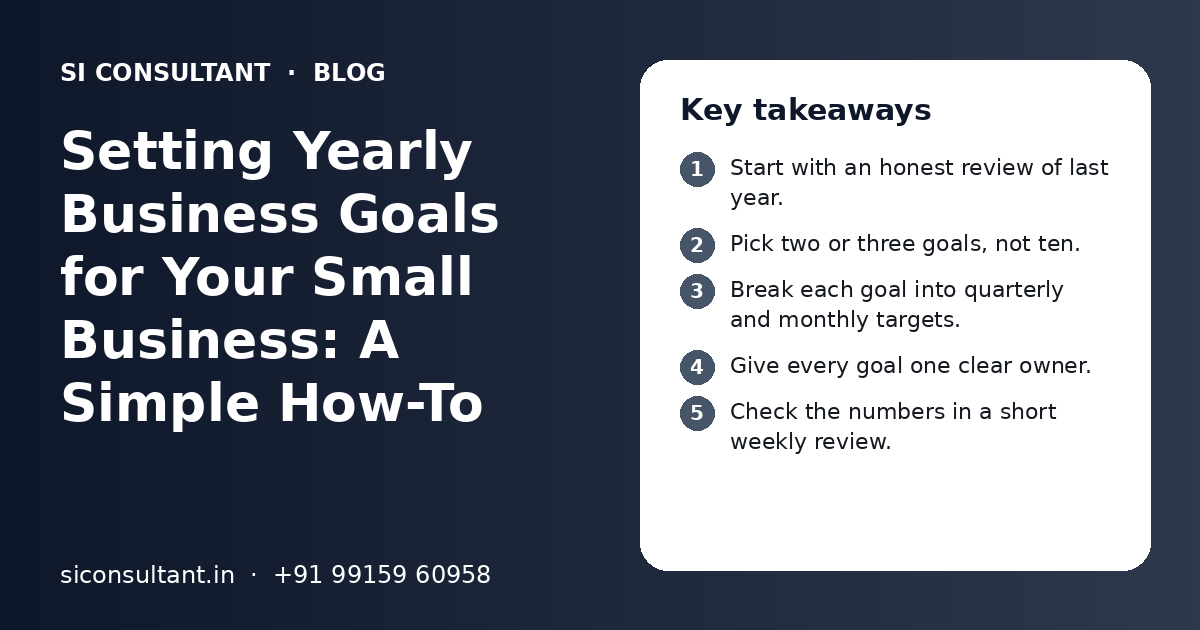
Key takeaways
- Start with an honest review of last year.
- Pick two or three goals, not ten.
- Break each goal into quarterly and monthly targets.
- Give every goal one clear owner.
- Check the numbers in a short weekly review.
Why should a small business set yearly goals?
Yearly goals tell your whole team what matters most this year. Without them, daily work and urgent calls decide where your time and money go.
In many SMEs, the owner keeps the plan in their head. Staff guess what is important. Money gets spent on whatever looks urgent. At year end, nobody can say if the year was good or bad, apart from a rough feeling.
Clear yearly goals fix this. They help you say no to the wrong work, plan hiring and spending, and give your team something to aim for.
In India, many owners plan around the financial year from April to March, since GST returns and books follow it. You can also use the calendar year. Pick one and stay with it.
How do you review last year before setting new goals?
Look at last year's real numbers first: sales, profit, cash, customers and what worked or failed. Goals built on facts are far more useful than goals built on hope.
Take half a day away from daily work. Pull numbers from your accounting software, GST returns, bank statements and CRM or sales register. Then answer these questions honestly.
- What were total sales, month by month?
- What was the real profit after all costs, including your own salary?
- Which products, services or customers made the most profit?
- Where did new customers come from: referrals, WhatsApp, Google, marketplaces, dealers?
- How many customers came back to buy again?
- Where did cash get stuck, such as in pending payments or extra stock?
- What did we plan last year that never happened, and why?
A SWOT analysis is a simple way to put this review on one page. It shows your strengths to build on and the weak spots that may block this year's goals.
How many yearly goals should a small business set?
Set two or three main goals for the year. A small team cannot push ten goals at once, and too many goals means none get proper attention.
Pick goals from different parts of the business so they support each other. For example, one money goal, one customer goal and one goal to fix how the business runs.
| Goal area | Example of a clear goal | Example of a vague goal |
|---|---|---|
| Sales | Reach a set yearly sales figure, decided from last year's numbers | Grow sales |
| Profit | Raise gross margin on our top products by a set amount | Make more profit |
| Customers | Get a set number of repeat buyers each month by March | Get more customers |
| Operations | Move all orders into one system by September | Be more organised |
| Team | Hire and train one sales person by the end of Q1 | Build a better team |
Every clear goal has a number, a deadline and a way to check it. If you cannot measure it at year end, it is a wish, not a goal.
How do you choose which goals matter most?
Choose goals that fix your biggest problem or open your biggest chance. Ask which one result would make the most difference to profit and cash this year.
Use your review. If profit is low but sales are fine, a profit goal matters more than a sales goal. If one big client gives most of your sales, adding new customers lowers your risk. If the owner handles every order, fixing operations frees your time for growth.
- 1
List every possible goal
Write down all ideas from the review, without judging them yet.
- 2
Score each on impact and effort
Mark each as high or low impact on profit and cash, and high or low effort.
- 3
Keep high impact goals
Pick two or three high impact goals. Prefer ones your team can start on now.
- 4
Check money and people
Make sure you have the cash, time and staff to chase each goal. Drop one if not.
- 5
Write them down
Write each goal in one line with a number and a date, and share it with the team.
If pricing is the real issue, our pricing strategy consulting page explains how to test it. If marketing spend has no plan, see marketing budget planning.
Need help with your project?
Talk to the SI Consultant team. Free first call, simple advice, clear quote.
How do you break yearly goals into quarterly and monthly targets?
Split each yearly goal into four quarterly targets, then into monthly targets. Adjust for your busy and slow seasons instead of dividing equally.
Most Indian businesses have seasons. Retail and gifting are busy around Diwali and the wedding season. B2B buying may slow down in some months and pick up near March, when many companies close their books. Use last year's month-by-month numbers to set fair targets.
| Level | What it answers | Who looks at it |
|---|---|---|
| Yearly goal | Where do we want to be by year end? | Owner and partners |
| Quarterly target | What must be true in three months? | Owner and team leads |
| Monthly target | What number must we hit this month? | Team leads |
| Weekly actions | What will each person do this week? | Each person |
Each quarter is a good time to pick the main projects that drive the goal. Our 90-day growth plan guide shows how to plan one quarter in detail.
Track the actions, not only the results
Sales figures come late. Actions come first. For a sales goal, also track leads, follow-ups, quotes sent and orders closed each week. Our sales process consulting page explains how to set these stages up.
Who should own each business goal?
Give every goal one owner who is responsible for progress and for raising problems early. Shared ownership usually means nobody owns it.
The owner of a goal does not do all the work alone. They track the numbers, plan the actions, ask for help and report in the weekly review. In a small business, the owner may hold one goal and give the others to a manager, partner or senior staff member.
Good goal ownership
- One named person per goal
- Owner has the authority and budget needed
- Owner reports progress every week
- Problems are raised early, without fear
Weak goal ownership
- The whole team owns it
- Owner must ask permission for every small spend
- Progress is checked only at year end
- Bad news is hidden until it is too late
For family businesses, decide owners openly in a meeting with all partners. This avoids confusion later about who decides what.
How do you run a weekly review of your goals?
Hold a short weekly meeting of 30 to 45 minutes where each goal owner shares the numbers, what got done and what is blocked. Keep it the same day and time every week.
- 1
Share the scorecard
Show this week's key numbers next to the monthly target, in a shared Google Sheet or Excel file.
- 2
Each owner reports
Each owner says if their goal is on track or behind, in two or three lines.
- 3
Solve one or two problems
Pick the biggest blocker and agree on a fix. Keep long talks for a separate meeting.
- 4
Agree on actions
Each person leaves with clear tasks for the next week, written down.
Send the action list on your team WhatsApp group or email the same day. Once a month, compare against monthly targets. Once a quarter, review the yearly goals and change them if the business has really changed. A simple CRM helps keep sales numbers honest. See our CRM selection consulting page if you need one.
What mistakes should you avoid when setting yearly business goals?
The most common mistakes are too many goals, goals with no numbers, no owner and no review. Each one turns a yearly plan into a forgotten document.
| Mistake | What happens | Better way |
|---|---|---|
| Setting too many goals | Team effort is spread thin | Keep two or three main goals |
| Goals with no number | Nobody knows if they were met | Add a number and a date |
| Only a sales goal | Sales grow but profit or cash falls | Add a profit or cash goal |
| Goals set by the owner alone | Team does not believe in them | Discuss targets with team leads |
| No weekly review | Plan is forgotten by May | Fixed weekly meeting with a scorecard |
| Never changing the plan | Goals stop making sense mid-year | Review and adjust each quarter |
Another mistake is setting goals far above what your cash and team can support. Growth needs money for stock, staff and marketing before sales come in. Our guide on mistakes to avoid when scaling a small business covers this risk.
How can SI Consultant help you set yearly business goals?
SI Consultant helps you review last year, choose the right few goals and build a simple quarterly plan and weekly scorecard your team can follow.
We start with your real numbers and an honest talk about what is working. Then we help you pick goals, break them into targets, name owners and set up a review rhythm. Our business consulting and growth consulting services can then support you through the year.
SI Consultant is powered by Shivah Web Tech, with 11+ years of experience, a 25+ member in-house team and 500+ projects. We work Monday to Friday, 9:30 to 6:30 IST, from Mohali. Contact us and you get a clear quote after a free call.
Frequently Asked Questions
When is the best time to set yearly business goals?
Set them a few weeks before the new year starts. Many Indian businesses follow the financial year from April to March, so February and early March work well. If you follow the calendar year, plan in December. This gives you time to review last year's numbers, discuss targets with your team and start the year with a clear plan.
How many goals should a small business set for the year?
Two or three main goals is a good number for most small businesses. A small team cannot give real attention to ten goals at once. Choose goals from different areas, such as one money goal, one customer goal and one operations goal, so they support each other instead of competing for the same time and cash.
What are some examples of yearly goals for a small business?
Common examples include reaching a set sales figure, raising profit margin on top products, getting a set number of repeat customers each month, launching an online store, hiring and training a sales person, or moving all orders into one system. Each goal should have a number, a deadline and one owner, based on your own past numbers.
Should I share business goals with my employees?
Yes, share the goals and the targets that each team affects. Staff work better when they know what matters and how their work connects to it. You do not need to share every financial detail. But your team should know the main goals, their own monthly targets and how progress will be checked each week.
What should I do if we are behind on our yearly goal mid-year?
First find out why, using the weekly numbers. Is it fewer leads, lower conversion, lower prices or a market change? Then fix the cause, such as adding a lead source or improving follow-ups. If the business has really changed, adjust the goal at the quarterly review. Changing a goal for a real reason is fine; ignoring it is not.
What is the difference between a yearly goal and a business plan?
A yearly goal is a specific result you want by year end, such as a sales or profit figure. A business plan is a longer document that explains your market, products, team, costs and how you will grow. Yearly goals often come from the business plan, and they turn it into clear targets your team can track every week.
Do I need software to track yearly business goals?
No. A shared Google Sheet or Excel file with a simple weekly scorecard is enough for most small businesses. What matters is that the numbers are updated every week and discussed in a fixed meeting. As you grow, a CRM or accounting software with reports can save time, but start simple and keep the habit going.