Quick answer
How do you do cash flow planning for a small business?
Cash flow planning for a small business means listing the cash you expect to receive and pay each week, usually for the next 13 weeks. Start with your bank balance, add expected collections, subtract fixed and variable payments, including GST and tax dates, and act early on any week that shows a shortfall.
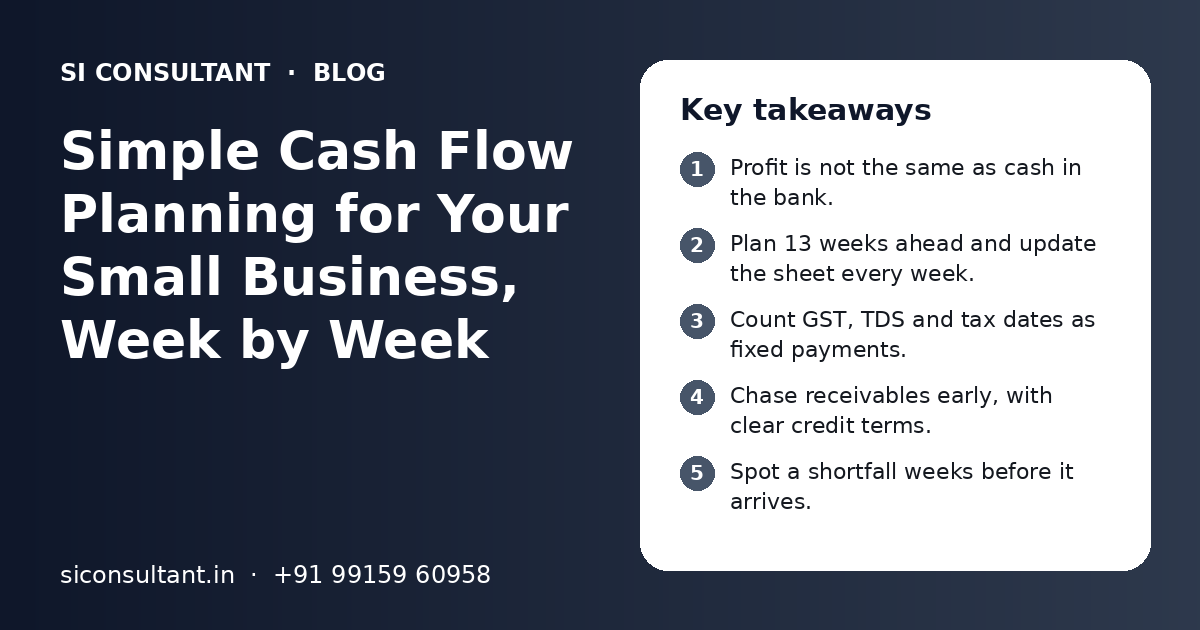
Key takeaways
- Profit is not the same as cash in the bank.
- Plan 13 weeks ahead and update the sheet every week.
- Count GST, TDS and tax dates as fixed payments.
- Chase receivables early, with clear credit terms.
- Spot a shortfall weeks before it arrives.
What is cash flow planning for a small business?
Cash flow planning for a small business is a simple forecast of the money that will come in and go out of your bank account, week by week. It tells you when cash will be short, so you can act in time.
It is not an accounting report from your CA. It is a working tool for the owner that answers one question: will I have enough money to pay everyone on time?
If you already know your break-even point, cash planning is the next step. Break-even tells you how much you must sell. Cash planning tells you when the money will actually arrive.
Why can a profitable business still run out of cash?
Because profit is counted when you make a sale, but cash arrives only when the customer pays. If customers pay late while your costs are due now, you can show a profit and still have an empty bank account.
| Point | Profit | Cash flow |
|---|---|---|
| When a sale counts | On the invoice date | When the money reaches your bank |
| Stock you buy | Counted as cost only when sold | Cash goes out when you pay the supplier |
| Loan repayment | Only the interest is an expense | The full EMI leaves your account |
| Owner's drawings | Not an expense in profit | Real cash going out |
| GST collected | Not your income | Sits in your bank until you pay it |
| Large equipment purchase | Spread over years as depreciation | Paid now, in one go or in instalments |
This is why growth itself can cause a cash crunch. More orders mean more stock, more staff and more credit given to buyers, all before the money comes back. Our post on mistakes to avoid when scaling a small business covers this in more detail.
How do you build a simple 13-week cash flow sheet?
Make a sheet with 13 weekly columns. Start with this week's bank balance, add expected cash in, subtract expected cash out, and carry the closing balance forward to the next week.
Thirteen weeks is about one quarter: short enough to predict, long enough to see trouble coming. Excel or Google Sheets is enough.
- 1
Set up the columns
One column per week for 13 weeks. Write the week start date at the top of each column.
- 2
Enter the opening balance
Add up all business bank accounts and cash in hand for the first week. Use the real figure from your bank app, not your books.
- 3
List cash coming in
Customer payments you expect, by week. Base them on how each customer actually pays, not on the due date on the invoice.
- 4
List cash going out
Rent, salaries, supplier payments, EMIs, GST, TDS, advance tax, utilities, software, marketing and owner's drawings.
- 5
Work out the closing balance
Opening balance plus cash in minus cash out. This becomes the next week's opening balance.
- 6
Mark the danger weeks
Highlight any week where the closing balance falls below a safety level you choose, such as one month of fixed costs.
- 7
Update every week
Replace the forecast with actual figures for the week just gone, and add a new week at the end.
A sample layout for your sheet
| Row | Week 1 | Week 2 | Week 3 | and so on to Week 13 |
|---|---|---|---|---|
| Opening balance | From bank | Week 1 closing | Week 2 closing | ... |
| Customer collections | Expected | Expected | Expected | ... |
| Other cash in (loan, owner funds) | If any | If any | If any | ... |
| Salaries and rent | Fixed | Fixed | Fixed | ... |
| Supplier payments | As agreed | As agreed | As agreed | ... |
| GST, TDS and tax | On due dates | On due dates | On due dates | ... |
| EMIs and other fixed costs | On due dates | On due dates | On due dates | ... |
| Closing balance | Calculated | Calculated | Calculated | ... |
How should you plan for GST, TDS and tax payments?
Treat GST, TDS and advance tax as fixed payments with fixed dates in your sheet. Ask your CA for your exact due dates and put them in the right weeks before anything else.
GST is a common cause of cash shocks. In most cases, GST becomes payable based on your invoice, not on the day the customer pays you. So if a buyer pays late, you may have to pay the GST on that sale from your own pocket first.
| Payment | How it affects cash | What to do |
|---|---|---|
| GST on sales | Due on set dates, even if the customer has not paid | Keep GST collected in a separate account or set it aside |
| Input tax credit | Reduces GST payable only when the supplier has filed correctly | Check your input credit with your CA before you count on it |
| Paying suppliers late | GST rules can make you reverse input credit if a supplier is not paid within 180 days | Do not delay supplier payments for too long |
| TDS deducted | Must be deposited by the due date each month | Add it to the sheet on the right week |
| Advance tax | Paid in instalments during the year | Plan the June, September, December and March weeks |
If you file under the quarterly scheme for small taxpayers, you still usually pay tax monthly. Confirm with your CA which dates apply to you. Rules change from time to time, so check every year.
A simple habit that helps
Each time a customer pays you, move the GST part of that payment to a separate savings account. When the GST date comes, the money is ready. This one habit removes a lot of stress.
Need help with your project?
Talk to the SI Consultant team. Free first call, simple advice, clear quote.
How can you collect payments from customers faster?
Agree clear payment terms before work starts, send invoices on the same day, make paying easy with UPI and bank details on every invoice, and follow up on a fixed schedule. Slow collections are the main cash problem for most small firms.
- Write payment terms in the quote and the invoice, such as advance, part payment or a set number of days.
- Take an advance for custom orders and new customers.
- Send the invoice on the day of delivery, not at month end.
- Add a UPI QR code and bank details to every invoice.
- Send a polite WhatsApp or email reminder a few days before the due date.
- Call on the due date, and again a week later, with one person responsible.
- Keep a simple ageing list: not yet due, overdue, and long overdue.
- Stop new credit for customers who are long overdue until they clear old bills.
If you are a registered micro or small supplier
If your business is registered as a micro or small enterprise under the MSME rules, buyers are expected to pay you within the agreed time, and the law sets an upper limit of 45 days. Mention your Udyam registration on your invoices and ask your CA how this applies to your buyers.
Your sales process also shapes how fast cash comes in. Our sales process consulting helps you set terms and follow-up steps that your team can stick to.
How do you manage payments going out without hurting suppliers?
Pay on the agreed date, not early and not late. Plan large purchases around the weeks when cash is strong, and talk to suppliers early if you need more time.
- Ask for credit terms that match how long your own customers take to pay.
- Buy stock in smaller, more frequent lots if storage and price allow.
- Move large one-time purchases to weeks with a healthy balance.
- Review monthly subscriptions and software you no longer use.
- Keep the owner's drawings at a fixed, planned amount.
Do not use supplier money as a free loan for too long. It damages trust, and with GST input credit rules, it can cost you more later. A clear stock and purchase system makes this easier. If your stock is hard to track, our ERP selection consulting can help you pick the right software.
What should you do when the plan shows a cash shortfall?
Act as soon as the sheet shows a red week. First speed up collections and delay non-urgent spending. If that is not enough, arrange short-term finance before the week arrives, not on the day.
Actions to try first
- Call customers with overdue bills and offer easy UPI payment
- Offer a small discount only for early payment of large bills
- Delay hiring or big purchases by a few weeks
- Speak to suppliers early about a short extension
- Talk to your bank about a working capital limit before you need it
Actions to avoid
- Delaying GST or TDS deposits
- Using personal credit cards for business bills
- Borrowing from informal lenders at high interest
- Delaying staff salaries without telling them
- Cutting marketing completely with no plan
Banks look at your plan and records before giving a working capital limit. Our guide to a business plan for a bank loan explains what to prepare.
What are the most common cash flow mistakes small businesses make?
The most common mistakes are confusing profit with cash, forgetting tax dates, giving credit with no follow-up and never updating the plan. Most of them are easy to fix once you see them.
- Looking only at sales and profit, not at the bank balance ahead.
- Making a cash plan once and then never updating it.
- Using due dates on invoices instead of real payment habits.
- Leaving GST, TDS and advance tax out of the plan.
- Mixing personal and business money in one account.
- Giving credit to new customers without checks or advances.
- Pricing so low that there is no buffer for late payments.
- Keeping no cash reserve for slow months or festival stock.
Low prices are a hidden cash problem. If your margin is thin, every late payment hurts more. Our pricing strategy consulting can help you review your prices, and our marketing budget planning service helps you spend in step with your cash.
How can SI Consultant help with cash flow planning?
SI Consultant can set up a simple 13-week cash sheet for your business, review your credit terms and collection process, and show you where cash gets stuck. We work alongside your CA, not in place of them.
A typical engagement covers a review of your sales, payment terms, purchases and fixed costs, a ready-to-use sheet in Excel or Google Sheets, and a short routine you can follow every week. It often sits inside wider business consulting or growth consulting work.
SI Consultant is powered by Shivah Web Tech, with 11+ years of experience, a 25+ member in-house team and 500+ projects. We work Monday to Friday, 9:30 to 6:30 IST, from our Mohali office. Cost depends on the size of your business and the support you need, so you get a clear quote after a free call. Contact us to book it.
Frequently Asked Questions
Why is cash flow planning important for a small business?
Small businesses usually have smaller cash reserves, so even one late payment can make it hard to pay rent, salaries or GST on time. A cash flow plan shows you a shortage weeks before it happens. That gives you time to chase payments, delay spending or arrange finance calmly, instead of rushing at the last minute.
How often should I update my cash flow sheet?
Update it once a week, on a fixed day. Replace last week's forecast with the actual bank figures, check which customers paid, and add a new week at the end so you always see 13 weeks ahead. It takes a short time once the sheet is set up, and it becomes a useful weekly habit for the owner.
What is the difference between a cash flow plan and a budget?
A budget sets targets for sales and spending over a year or a month. A cash flow plan shows when money will actually enter and leave your bank, week by week. You can be within budget and still run short of cash if customers pay late. Most small businesses benefit from using both.
Can I do cash flow planning in Excel or Google Sheets?
Yes. A simple spreadsheet is enough for most small businesses. You need one row for each type of cash in and cash out, and one column for each week. Accounting software can help by showing outstanding invoices and bills, but the weekly cash view is usually easiest to build and update in a sheet.
Should I keep GST money in a separate bank account?
Many owners find it helpful. GST you collect from customers is not your income. If it stays in your main account, it is easy to spend by mistake. Moving the GST part of each payment to a separate account means the money is ready on the due date. Ask your CA how best to set this up for your business.
How much cash reserve should a small business keep?
There is no single right number. It depends on how steady your sales are, how fast customers pay and how large your fixed costs are. Many owners aim to cover a few months of fixed costs such as rent, salaries and EMIs. Use your 13-week sheet to see your weakest weeks and set a reserve that covers them.